Saturday, June 1, 2013

The Episcopal Church's Katharine Jefferts Schori and Hermeneutical Irresponsibility


(image@commons.wikimedia.org)

Back when I taught hermeneutics (the study of how to interpret Scripture) to freshman undergraduates at a Christian college, I invariably opened the first lecture with a story I had heard from Moisés Silva. According to the story a sophisticated minister of a mainline Protestant church in Philadelphia's wealthy Main Line preached a sermon on Acts 5:1-11. This famous story narrated in that text tells of the unfortunate demise of Ananias and Sapphira after being rebuked by St. Peter for lying about the extent of their largesse in giving to the apostolic community pot. Of one thing there can be no doubt: the author, Luke, considered their deceit to be, in effect, a lie against the Holy Spirit (5:3), and their subsequent death visible evidence of God's judgment on the pair (5:5, 11). Indeed, Luke deliberately juxtaposes the behavior of Ananias and Sapphira with the contrasting generosity of Barnabas, who sold a field he owned and presented the proceeds to the apostles for distribution among the community (Acts 4:32-37). In Luke's theological vision, the judgment of the couple demonstrated quite clearly that there was no room for such characteristically fallen human behavior in the newly minted eschatological people of God, whom Luke labels the "church" for the first time in this text (5:11). But for the sophisticated Philadelphia minister the point was otherwise. The real "bad guy" of the story, in his view, was Peter, whose verbally abusive invective was to blame for what was, in effect, the pair's death-by-bullying.


My students, almost all of whom came from very conservative ecclesial backgrounds, were invariably shocked and puzzled about how anyone could have derived such an interpretation from such a seemingly straightforward text. And for that reason the illustration was a perfect one, introducing them in a hurry to the vagaries of postmodernistic approaches to the book they had matriculated to study. For years I thought I would never hear another example of such a patently eisegetical (i.e., reading one's own ideas into the text) interpretive practice from a "respectable" churchman/woman. But that was before I encountered the sermon preached by Jefferts Schori at All Saints Church, Curacao, on the 12th of May. Citing the story of St. Paul's encounter at Philippi with a demonically-controlled clairvoyant servant girl (Acts 16:16-24), the bishop not surprisingly uses the incident as a polemic against the apostle's supposedly small-minded, petulant refusal to see the girl's "spiritual awareness" as "beautiful" and "holy":
We live with the continuing tension between holier impulses that encourage us to see the image of God in all human beings and the reality that some of us choose not to see that glimpse of the divine, and instead use other people as means to an end. We’re seeing something similar right now in the changing attitudes and laws about same-sex relationships, as many people come to recognize that different is not the same thing as wrong. For many people, it can be difficult to see God at work in the world around us, particularly if God is doing something unexpected.
There are some remarkable examples of that kind of blindness in the readings we heard this morning, and slavery is wrapped up in a lot of it. Paul is annoyed at the slave girl who keeps pursuing him, telling the world that he and his companions are slaves of God. She is quite right. She’s telling the same truth Paul and others claim for themselves. But Paul is annoyed, perhaps for being put in his place, and he responds by depriving her of her gift of spiritual awareness. Paul can’t abide something he won’t see as beautiful or holy, so he tries to destroy it. It gets him thrown in prison. That’s pretty much where he’s put himself by his own refusal to recognize that she, too, shares in God’s nature, just as much as he does – maybe more so! The amazing thing is that during that long night in jail he remembers that he might find God there – so he and his cellmates spend the night praying and singing hymns.
Sadly, this is not the first time I have written about Jefferts Schori and the pathetic state of the Episcopal Church in the USA of which she is Presiding Bishop (see here and here). This is particularly sad for me as one who claims a heritage in the Church of Ireland and whose own father was baptized as an infant in the Episcopal Church. Nevertheless, one wonders if it is simply too late for this branch of the Anglican communion that clearly prefers the spirit of this age to the Spirit who inspired Scripture (2 Tim 3:16), that would rather abide by the canons of political correctness than those of responsible hermeneutics. For, as even an elementary Bible student should quickly recognize, her use of the biblical story is simply ludicrous if meant to be an example of how to interpret Scripture. The Book of Acts, as I'm sure the bishop was taught (at least I hope she was), is Luke's account of how the Holy Spirit worked through the apostles, especially Peter and Paul, to spread the gospel and build the church from Jerusalem, through the entire eastern Mediterranean region, all the way to Rome. Paul, to put the point bluntly, was Luke's hero (and likely companion during much of the narrative), the ultimate apostolic example, not one whose witness to the gospel is a prime target for deconstruction and condescending postmodernist (and in this case, implicitly feminist) criticism.

A moment's reflection will reveal that Jefferts-Schori's criticism of St. Paul is triply ironic. In the first place, she prefers to speak of the girl as one having "spiritual awareness" and who perhaps "share[d] in God's nature" even "more so" than the apostle did. But Luke, the only witness we have to this event, identifies her as having a "spirit of divination" (Acts 16:16) that was subsequently exorcised successfully by the apostle. Surely the bishop has the "spiritual (or at least historical) awareness" to realize that divination is not only condemned quite explicitly in the Torah (Deuteronomy 18:10), but is given negative narrative coverage in the story of Balaam in Numbers 22-24 as well. Or are we to suppose that the Episcopal Church, in the person of its presiding bishop, is now open to the occult and divination of any kind? One hesitates even to ask the question.


Second, noting that the girl was "quite right" in "telling the world that [Paul] and his companions [were] slaves to God," Jefferts-Schori considers the apostle's response as irrational and short-sighted. Why, she wonders, would Paul silence one whose words apparently showed her to be on the same side as he? Indeed, after the conversion of the Philippian jailer and his household, Jefferts-Schori waxes contemplative: "It makes me wonder what would have happened to that slave girl if Paul had seen the spirit of God in her." Well, I would like, as it were, to see the good bishop and raise her with an example straight from the Gospels featuring none less than Jesus himself. Would she, I wonder, similarly critique her Lord? Mark records an event from early in Jesus' Galilean ministry in which Jesus encountered a man in the synagogue at Capernaum who was indwelt by an "unclean spirit" (Mark 1:21-28). The spirit, using the man as a mouthpiece, cried out, "I know who you are—the Holy One of God" (Mark 1:24). The spirit's utterance was, from Mark's perspective, theologically correct (cf. Mark 1:1; 15:39). Nevertheless, Jesus promptly rebuked it and said, "Be silent, and come out of him" (Mark 1:25). One suspects Jefferts-Schori would not be so cheeky as to criticise Jesus for this silencing of theologically accurate publicity, but on what basis?


Third, and most ironic of all, Jefferts-Schori, the avowed "progressive" who is concerned above all to eradicate the injustices perpetrated on the marginalized, has apparently forgotten that Luke explicitly speaks of the exploitation of the girl's "ability" by her owners for their financial gain (Acts 16:16). Failing to make this elementary observation, the bishop prefers to see Paul's imprisonment as a consequence of his own refusal to recognize the girl's spiritual awareness. Luke will have none of such skybala, however. For him the arrest of Paul and Silas was due to the spite of the owners, who saw their cash cow silenced with the spirit's exorcism (Acts 16:19-24). One may try, but one cannot have it both ways.


In a sense, the remarks of Jefferts-Schori are just one more piece of evidence for the hatred that so many supposedly "tolerant" liberal Christians have for St. Paul, and the lengths to which they are prepared to go to discredit him and his witness. But the more basic issue here is one of Christian definition. What does it mean to be a Christian? What role does Scripture play in determining that definition? Historically, being a Christian meant commitment to Christ in the context of the scripturally-controlled regula fidei ("rule of faith"). Today, however, large swaths of the western church seem to think they can follow certain Jesuanic principles (mainly love of neighbor, anti-legalism, so-called "tolerance," and care for the poor) and cast off the rest of the inconvenient bits like St. Paul as mere husk fit for the rubbish heap. To do so, of course, makes it much easier to adapt to the spirit of the age. But doing so decontextualizes the thrust of Jesus' teachings and jeopardizes the legitimacy of the entire enterprise. 


People such as Bishop Jefferts-Schori have every right to believe as they do and to propagate their views. What they don't have a right to do is to pass off such views as Christian. As St. Augustine wrote in the late 4th century:  "You ought to say plainly that you do not believe the gospel of Christ. For to believe what you please, and not to believe what you please, is to believe yourselves, and not the gospel" (Contra Faustum, 17.3). 

Friday, May 31, 2013

Remembering the 1983 Sixers


The Battle in the Middle: The Sixers' Moses Malone and the Lakers' Aging Warrior, Kareem Abdul-Jabbar
(image@nba.com)


Today marks the 30th Anniversary of the happiest night I have ever experienced as a sports fan. That was the night my hometown Sixers exorcised the demons of six years of frustration that had tormented the franchise ever since they scored a major coup in buying the contract of Julius Erving from the New York Nets prior to the 1976-77 season. They did it by defeating the Los Angeles Lakers, 115-108, in game 4 of the NBA Championship Series to complete an improbable sweep of the defending champs.

I had experienced Philly championships before, of course: the 1966-67 Sixers, the 1973-74 and 1974-75 Flyers, and the 1980 Phillies. But this wasn't the San Francisco Warriors or Kansas City Royals the Sixers were facing. This was the hated Lakers of Magic Johnson and Kareem Abdul-Jabbar, the vaunted dynasty who had defeated the Sixers in two of the previous three championship series and would go on to defeat the Boston Celtics to win the championship in both 1985 and 1987. And, most importantly, the Sixers did it in an utterly dominating fashion that no other team in the city's history has ever duplicated.

The Sixers' road to glory began in 1975 when, just 3 years removed from amassing the worst 82-game record in NBA history (9-73 in 1972-73; the 2012 Charlotte Bobcats, who went 7-59, were even worse in that shortened season), they lured ABA superstar forward George McGinnis away from the Indiana Pacers. Big George teamed with guards Doug Collins and Fred Carter to lead the team to 46 victories and the franchise's first playoff appearance in 5 years. When Erving was purchased the following fall, the Sixers immediately catapulted into the league's upper echelon. Led by Erving, McGinnis, and Collins, the Sixers led the Eastern Conference with 50 wins and defeated the Houston Rockets to earn a spot in the 1976 Championship Series with Bill Walton's Portland Trailblazers. Despite winning the first two games at home (in both of which I was in attendance), the team faltered, losing 4 straight with McGinnis mired in a dreadful slump and Maurice Lucas distracting the youthful Darryl Dawkins with a fight in game 2. The team, it was felt by the entire city, had a lot of unfinished business to attend to. The team seemed to agree, starting an ad campaign in the fall of 1977 with Erving looking directly into the camera and saying, "We owe you one. We owe you ... one." (Never mind that the Doctor later was candid enough to admit he never thought they owed anybody anything.)

But, as anyone familiar with the vicissitudes of Philadelphia sports could have predicted, the one turned into two as the Sixers, despite coasting to 55 victories in the regular season, lost to the Washington Bullets in the Eastern finals, due in part once again to the subpar performance of McGinnis. As a result, the Sixers dealt the offensive-minded McGinnis to Denver in exchange for defensive specialist Bobby Jones, a sound move that would reap dividends in just a few seasons.

After a disappointing 1978-79 season, the team rebounded with a vengeance in 1979-80, winning 59 games, bettered by only the Boston Celtics' 61 and the Lakers' 60. But they whipped the Celtics in 5 games in the Eastern Conference finals, only to succumb to the Lakers when rookie Magic Johnson scored 40 points in the absence of MVP Abdul-Jabbar in the deciding 6th game. The following season the team was even better, winning 62 games (tied with Boston for most in the league) with Erving named the league's MVP. Nevertheless, in shades of 1968, disaster struck in the Eastern Conference finals against the Celtics. Up 3 games to 1, the Sixers promptly lost three straight by a total of 5 points, allowing the Celtics to proceed to the finals to demolish the overachieving Houston Rockets. The following year was more of the same: 58 wins (second only to the Celtics' 63) and an Eastern finals duel with the Celtics. Once again, the Sixers jumped to a 3-1 advantage, only to lose badly in games 5 and 6. The Dallas Times Herald's Skip Bayless dubbed them "Chokeadelphia" and confidently predicted a Celtic victory in game 7. Second-year guard Andrew Toney had other ideas, however, earning the nickname "The Boston Strangler" with an electric 34-point performance to lead to Sixers to victory. Once again, it was the Lakers, not the Rockets, who awaited the Sixers in the finals. And, once again, the Lakers prevailed in 6 games. The Sixers, it seemed, were at an impasse. They needed to do something to push them over the top. And so, like the team did so often in the 1970s and early 1980s, they did something.

The Doctor in Action
(image@bleacherreport.com)

What they did was trade solid center Caldwell Jones for the man who was quickly becoming the league's most dominant big man, Houston's relentless Moses Malone. The results were dramatic. After 57 games, the Sixers had blown away their competition with a 50-7 record. Four of their starting five were selected to play in the All-Star Game: Malone, Erving, Toney, and point guard Maurice Cheeks, the paragon of selflessness and reliability. All told, the Sixers ended with a 65-17 record, second best in franchise history behind the 1967 team's 68-13 mark. Malone averaged 24.5 points and 15.3 rebounds per game to run away with the league's MVP award. The gracefully aging Erving chipped in by averaging 21.4, while the assassin-like Toney used his arsenal of drives and jumpers to average 19.7.


But they were just getting started. Malone set the stage by predicting a clean sweep of the playoffs, a feat never before accomplished: the Sixers would win in "fo', fo', fo'." Well, the feat still has never been accomplished, but the Sixers came close. In the Eastern Conference Semifinals, they defeated the New York Knicks, 4 games to 0. In the Eastern finals, they defeated the formidable Milwaukee Bucks in 5 games. They only faltered in game 4, when the Bucks used a 4th quarter rally to avoid the sweep. This inexorably brought on yet another finals date with the hated Lakers, who had vanquished George Gervin's San Antonio Spurs in 6 games.

The Boston Strangler
(image@nba.com)
The Sixers won two hard-fought games at home before whipping the Lakers, 111-94, in Los Angeles in game 3. In game 4, the "Showtime" Lakers jumped to a 65-51 halftime lead, and were still leading by 11 going into the 4th quarter. But it was that 4th quarter which demonstrated to me how great that 1983 Sixers really were. Throughout the quarter they chipped away at the lead until, with just over 2 minutes to play, Erving stole a pass and took it all the way to put the Sixers up for good. As a fitting coda, tiny Mo Cheeks punctuated the victory with a breakaway dunk (the only one I ever saw the Hall-of-Fame worthy player make in his long career) as time was expiring. The Sixers were simply too good in every phase of the game. They were, above all, too explosive to be stopped by anyone but themselves. Malone ended the game with 24 points and 23 rebounds. Toney added 23 points and 9 assists. Erving added 21 and Cheeks 20.


And they made no 3-point shots the entire game (indeed, they only attempted one, a Toney miss). Indeed, watching that game again after 30 years impresses one as to how much the game of professional basketball has changed—and not for the better—in the past thirty years. Players moving without the ball, few isolation plays with 8 players standing around, mid-range shots, a lack of "physical," Detroit Piston "bad boy" defense (i.e., how the game was designed to be played), centers who actually play the post like centers, and dominate as a result. These are all elements of the game I love which are all too rarely found in today's edition of it. And waning popularity with large segments of the population is the result.


(image@sbnation.com)
It is difficult to assess the lasting legacy of this team. Each of the next three seasons they won more than 50 games, but never again reached the finals. Drafting Charles Barkley in 1984 somewhat offset the decline of Erving due to age and Toney due to a chronic foot injury. But the final straw came when the Sixers traded Malone, their best player, after the '85-'86 season for Jeff Ruland, whose name has become proverbial in Philadelphia for "damaged goods." Thus the '83 Sixers, as great as they were, never were a dynasty, and it is for this reason that they are, in my view, chronically underrated when lists of the NBA's greatest teams are drawn up. But that is a shame. In my 50 years of watching the game, I can think of only two—Wilt Chamberlain's '67 Sixers and '72 Lakers—that I would rate as clearly better. The two teams they most resemble in terms of dominance are their peers, the '85-'86 Celtics of Larry Bird and the '86-'87 Lakers of Magic Johnson. Michael Jordan's 1995-96 Bulls that won 72 games? Sorry, as great as Michael was, the rest of his cast couldn't hold a candle to the "supporting players" who played with Wilt, Moses, Larry, and Magic.

In the 30 years since that long ago May evening, Philadelphia's four major sports franchised have won a grand total of one championship (the 2008 Phillies). This is a drought of major proportions. By comparison, New York (including New Jersey) has won 14, Los Angeles 13, Chicago 9, Boston 9, Detroit (!) 8, San Francisco/Oakland 6, Dallas 5, and even tiny Pittsburgh 5. The magnitude of the drought has caused this hot-headed, pessimistic Irishman no small consternation. Upon reflection, however, I settle down in recognition that this is how it's always been in Philly (I first started following pro sports in earnest with the 1964 Phillies, after all!). And the prolonged dry periods only serve to make the rare championships all the sweeter. And for that the names of Moses Malone, Julius Erving, Andrew Toney, Mo Cheeks, and Bobby Jones will always bring a smile to my face.


(image@bleacherreport.com)


Friday, May 24, 2013

Elmore James Remembered


(image@emusic.com)


Today marks the 50th anniversary of the death, by heart attack at the age of only 45, of one of the true, under-recognized greats of post-War Chicago Blues, Elmore James. Indeed, I would venture to guess that many of those who have even heard of James know of him only via an off-hand remark by blues scholar Dan Aykroyd's Elwood J. Blues in the 1980 film The Blues Brothers. But if one has ever listened to the early, Brian Jones-led Rolling Stones, Jimi Hendrix, The Allman Brothers, Johnny Winter, ZZ Top, Stevie Ray Vaughan, Jimmie Vaughan's Fabulous Thunderbirds, or even the Beatles (on their late song "For You Blue" from Let It Be), one has heard the indelible lick for which James is most famous. This, of course, is the bottleneck slide electric guitar-propelled shuffle which he learned from fellow Mississippian Robert Johnson, which was destined to become one of the most recognizable sounds of the blues and its popularized offspring, rock 'n roll.

James's signature song, which gave his backing band their name ("The Broomdusters"), was an electrified version of Johnson's 1936 classic, "(I Believe I'll) Dust My Broom." James, who recorded for multiple labels in the 1950s, recorded the song for each of them, including Flair in 1955, on which, for copyright reasons, he had to rename the song "Dust My Blues." The riff is so perfect, and James's vocals so impassioned, that this is a tune of which I never get tired. I leave you with a number of versions of the song for your listening pleasure.

1. James's original recording for Trumpet Records, Jackson, Mississippi, 1951, with Sonny Boy Williamson II (Rice Miller) on harp:


2. James's searing early-1960s recording on Fire, with saxophones replacing Williamson's harp:


3. Robert Johnson's original 1936 acoustic version:


4. Howlin' Wolf (with a youthful Hubert Sumlin on guitar and an aged Son House snapping his fingers), from 1966:


5. Johnny Winter and The Allman Brothers Band, 1972 (Johnny and the late Duane Allman: history's two greatest slide players):

http://www.youtube.com/watch?v=EBEEQNHi7AU


6. Johnny Winter with Derek Trucks, 2012:


Wednesday, May 22, 2013

Chris Broussard, Jason Collins, and Assessing Genuine Christianity


(image@hollywoodreporter.com)
(image@usa.com)


[For my initial reflections on this matter, see here]

Buried deep beneath the surface of the recent media hullabaloo over the self-"outing" of NBA center Jason Collins is Collins' own claim to be a Christian. Such a claim runs counter to the opinion of many, including ESPN commentator (and Christian) Chris Broussard, who has been roundly condemned by the secular public (and segments of American Christianity as well) for the following comments he made on air about the issue:

Personally, I don’t believe that you can live an openly homosexual lifestyle or an openly, like premarital sex between heterosexuals. If you’re openly living that type of lifestyle, then the Bible says you know them by their fruits. It says that, you know, that’s a sin. If you’re openly living in unrepentant sin, whatever it may be, not just homosexuality, whatever it maybe, I believe that’s walking in open rebellion to God and to Jesus Christ. So I would not characterize that person as a Christian because I don’t think the bible would characterize them as a Christian.
Even a generation ago, such comments wouldn't have rustled the leaves of public opinion, let alone sparked the outrage that has led such organizations as MoveOn.org and (allegedly) Faithful America to call for Brouusard's suspension because of his "hateful" opinion. Of course, that was a time before the politics of gender identity and sexuality gathered momentum to the point where they now outpace the science they assume validates their views and which, by the way, needs to be taken into consideration by many of those with more "traditional" views on the matter.

Collins, however, cites his own Christian upbringing as influential in developing his own worldview:
I’m from a close-knit family. My parents instilled Christian values in me. They taught Sunday school, and I enjoyed lending a hand. I take the teachings of Jesus seriously, particularly the ones that touch on tolerance and understanding. On family trips, my parents made a point to expose us to new things, religious and cultural. In Utah, we visited the Mormon Salt Lake Temple. In Atlanta, the house of Martin Luther King Jr. That early exposure to otherness made me the guy who accepts everyone unconditionally.
In the wake of Broussard's commentary, many self-identified Christians have tripped over themselves in the rush to condemn Broussard condescendingly ("Those benighted evangelical traditionalists ...") and lend their support to Collins for his "courage" in outing himself. In the Washington Post, twelve Christian leaders, among them the openly gay Bishop Gene Robinson, opined that it's "okay to be gay and a Christian." Such opinions as those shared by Broussard, it is alleged, "[misrepresent] the ever widening nature of the gospel of Christ, who engaged with those on the margins, and placed in leadership people who were not powerful by worldly standards." They rejoiced that Collins now "has the freedom to be faithfully and authentically himself with the world," and expressed the prayer that "God will open the eyes of Chris Broussard and help him mature in his faith." As they continue their major perspective shines forth brightly:
May Broussard see that Christianity is not a faith that is closed off to those who are different from him, but one that continually expands, reaching out to the neighbor and the stranger, sharing the good news. We encourage Broussard to listen with humility to LGBT Christians, their lives and stories. It is through listening that we learn."
Meanwhile, over at the Huffington Post, the openly gay UCC minister Emily Heath, while acknowledging Broussard's right to express his opinions, lamented that Broussard, in effect, invalidated the faith of, not only Collins, but of innumerable people like her. According to Heath, it's not for him to decide who is and who is not a Christian: "what I am sure of is that Jason Collins should be the one defining his own faith, and not Chris Broussard." She continues:
For most of us who are gay and Christian, we understand that some Christians believe we are "living in sin." We also understand that our faith does not hinge on their acceptance. While people like Broussard believe we are "walking in open rebellion to God and Jesus Christ," we are pretty sure that we are actually living as the people God created us to be. And so, really, it doesn't matter much whether or not Chris Broussard has seen fit to "characterize" us as Christian. That's not his call.
Even straight Christians got into the act. At the Huffington Post, Presbyterian minister Richard Brand reminded us of the commonplace observation that "Jesus himself said absolutely nothing about homosexuality." Anyway, such a strict attitude about matters of sexual morality is, in Brand's view, somewhat beside the point:
Jesus seemed to be much more concerned about our relationship with each other, caring for the poor, feeding the hungry, visiting the sick and those in prison, caring for the widows and children, giving our wealth to the needy, than he was about strict rules and obedience to some rigid rituals.
Finally, over at Red Letter Christians, Kathy Vestal announced that we should all be "proud" of Jason Collins, not for being gay, but "for being courageous enough to put his own life on the line in the hopes of making tomorrow just a little better for someone else."

At bottom the issue is one of definition. What does it mean to be a Christian? Is anyone in a position to define the requirements so as to exclude others who may desire to be labeled as a Christian? For many, like Rev. Heath, the answer to the latter question is a clear "No." It is for each of us to define our "faith" on our own terms. For most of Collins's lionizers, however, there appears to be a tacit understanding that being a Christian simply means accepting Jesus' teachings, though the scope of those teachings seems to be tendentiously circumscribed. Collins himself points to Jesus' teachings on "tolerance and understanding." The signers of the article in the Washington Post point to Jesus' practice of welcoming the marginalized. Brand speaks of Jesus' ethic of love, manifest in the treatment of the poor, as relativizing such matters as "strict rules." And, lying just underneath the surface of the discussion is the subtext that Jesus' gospel frees people to be the people they were "created" to be, people who would remain oppressed if traditional ways of thinking were perpetuated.


Of course, such thinking allows for a lot of leeway in defining who is a Christian.  And that certainly serves the agendas of those who would like to marginalize large swaths of the Christian canon, particularly liberal Protestantism's bête noire, St. Paul. The New Testament, however, is hardly as nebulous as they would like. Simply put, a Christian is a disciple of Christ (Acts 11:26). Being such, according to the church's earliest tradition, involves both commitment to Jesus and persevering adherence to the well-defined theological content of what the New Testament authors refer to as the "gospel" (cf. 1 Corinthians 15:1-4). At bottom, as St. Paul writes elsewhere, a Christian is one who confesses that Jesus is the risen Lord (Romans 10:9-10). Such commitment, however, carries with it demands that cannot simply be shunted off to the side and conveniently ignored. Our Lord himself said:
“Why do you call me, ‘Lord, Lord,’ and do not do what I say? As for everyone who comes to me and hears my words and puts them into practice, I will show you what they are like. They are like a man building a house, who dug down deep and laid the foundation on rock. When a flood came, the torrent struck that house but could not shake it, because it was well built. But the one who hears my words and does not put them into practice is like a man who built a house on the ground without a foundation. The moment the torrent struck that house, it collapsed and its destruction was complete.” (Luke 6:46-49, NIV)
Over the years I have taken a lot of heat for pointing out how American Christians to my right have failed to grasp the implications of living by what Scot McKnight has called "The Jesus Creed" (i.e., love God and one's neighbor). The point likewise applies to those Christians on my left. Love is indeed the mark of the Christian. And love for one's neighbor certainly entails sacrifice for the poor and marginalized. But such concerns for love and social justice cannot legitimately be played off against the so-called moral demands of the Torah. Rev. Brand implicitly lumps people like Broussard together with the Pharisees, those "nitpickers" who ignored the prophetic call for mercy in the interests of strict law-keeping (e.g., Matt 9:13). Elsewhere, however, Jesus tells his disciples to "observe whatever [the Pharisees] tell you" (Matt 23:1-3) because of their scrupulous desire to obey the very Torah Jesus came to "fulfill" (Matt 5:17), and whose imperatives he proceeded to intensify in terms of a radical focus on the inward dimension of its demands (Matt 5:21-48).

Collins and his supporters point, quite rightly, to Jesus' call of the marginalized and, indeed, of "sinners." In contrast with Jewish sectarianism that drew the lines ever more tightly around those who "really" obeyed the Torah, all in the hopes of hastening the advent of the anticipated Kingdom of God, Jesus, like his predecessor John, called the entire nation to repent and to put that repentance into concrete, observable action. As was to be expected, Jesus' message implicitly pointed to the inadequacy of the piety of even the most observant Jews, and was accepted primarily by those who brought nothing, morally or religiously speaking, to the table (that's the point, by the way, of the famous parable of the Prodigal Son, at least in its historical Sitz im Leben).

But the point that so many "progressive" Christians ignore is that societal "marginalization" per se is not the issue. The Pharisees, not to mention the sectarian Essenes, were not wrong in condemning the moral laxity of "sinners," prostitutes, and tax collectors. Where they went wrong was in the assumption that they, by their intensified observance of the Law, could be shown to be the true "remnant of Israel" and hasten the advent of the Kingdom of God, and their own concomitant vindication, thereby. They failed, in other words, to realize that they, just like the "sinners" they condescendingly despised, needed to repent and get with Jesus' kingdom program. When we get to the post-Pentecost situation of the early church, the matter is intensified further when, through St. Paul, Gentiles—the ultimate "outsiders"—are included as full members of God's eschatological covenant people. Yet the rationale for their inclusion is not some merely humanitarian concern for their previous "marginalization," but rather is eschatological, based on the understanding that God was now fulfilling his promise to Abraham to have a world-wide people. And their inclusion was not without cost to them: they had to "[turn] from idols to serve the living and true God" (1 Thessalonians 1:9).


Indeed, it is a basic hermeneutical mistake to proceed as so many today do, namely, to argue as follows: (1) Jesus accepted the "marginalized" in his day; (2) Therefore, Jesus accepts the "marginalized" today; (3) homosexuals are marginalized in American society; (4) Therefore, Jesus accepts homosexuals today just as they are. In a sense, of course, it is entirely true that Jesus (and God) accepts people as they are. He can hardly do otherwise, and all without exception are, in biblical parlance, "ungodly" (Romans 4:5), with nothing in their hand to bring to the table. True as that is, however, God does not allow sinners to  remain "as they are" after coming to Christ. Nor did Jesus in his ministry in Judea and Galilee in the early 30s CE. Just as rich, unethical tax collectors like Zacchaeus demonstrated their conversion by tangible acts of restoration, so adulterers and other such "sinners" gave up their sinful ways upon joining the company of Jesus' disciples.

Even though the story clearly is not part of the Gospel of John as originally written, the famous pericope of the woman caught in adultery (John 7:53-8:11) comports well with what we know of Jesus elsewhere. Some scribes and Pharisees, desirous of "testing" and trapping Jesus (akin to their desire to trap Jesus in the matter of Roman taxes [Mark 12:13-17]), bring to him a woman who was caught in the act of adultery. Should she, they ask,be stoned, in accordance with the Torah? (in light of the Deuteronomic injunction of Deut 22:22-24, some have suggested she was in fact betrothed at the time; though cf. Ezek 16:38-40). Jesus, however, refuses to answer their question. Instead, he simply says to them: "Let the one who is without sin among you cast the first stone" (John 8:7). Unfortunately, this saying has been popularly understood to portray a "liberal" Jesus who plays fast and loose with the strictures of the Law, reducing them to little more than inconvenient adiaphora. The verse, however, deliberately echoes Deuteronomy 13:9 and 17:7, where the Torah says the witnesses must be the initiators of the execution by casting the first stones. Jesus is not saying that one must be a paragon of sinless perfection to be able to judge adultery (Carson). Such would invalidate even the office of judge. Rather, it means that the one doing the casting must not have been guilty of the sin in question. Here this might be a tacit acknowledgement that the scribes and Pharisees in question had conspired to set the woman up, in which case they could have been viewed as abettors of the offense and clearly in attitudinal violation of the Torah, whether or not any of them had actually been guilty of the physical act of adultery.

Most important, however, is Jesus' ultimate response to the woman herself: "Go, and sin no more" (poreuou, [kai] apo tou nyn mēketi hamartane) (John 8:11). The use of the present tense in the prohibition may be meant to indicate that Jesus was aware of her actual guilt in the matter. More importantly, however, the command indicates that Jesus, even as the merciful Judge, does not condone sin and, indeed, disallows continuance in it for those who would follow him in discipleship.

This means, of course, that everything hinges on whether or not it can be determined whether or not Jesus would have condemned homosexual practice. This brings us back, once again, to the observation, repeated ad nauseum in the current discussion, that Jesus never discusses the issue. More "progressive" types like to deduce from this that the issue is thus not essential to Christianity, and that such matters as "love" ought to define our response to this as to other issues, even if that means overturning what the rest of the Bible says about it. 


Such is merely a diversionary tactic, however, using contemporary understandings of what "love" entails to marginalize inconvenient material elsewhere in Scripture. In any case, even if it mattered, the observation about Jesus' non-mention of the issue is true only at the explicit, surface level. As I argued in depth last summer, both the Jewish context in which he ministered and his definitive comments on God's purposes for human sexuality as laid down in Genesis 2 demonstrate without serious doubt that Jesus, like all his Jewish contemporaries, would have condemned homosexual behavior as counter to God's intention for humankind and, hence, as sinful and not an option for his followers. And this means that what, not only the Old Testament, but St. Paul as well say about homosexual activity cannot legitimately be squeezed out of the conversation.


And Paul is clear, not only in Romans 1 but in 1 Corinthians 6 as well, that such activity is sinful. What he says in the latter text is most instructive, for it speaks directly to the issue for which Chris Broussard is being vilified, namely, whether one can be an active, unrepentant homosexual and still consider oneself a Christian. The relevant text reads as follows:
Or do you not know that the unrighteous will not inherit the kingdom of God? Do not be deceived: neither adulterers, nor men who practice homosexuality, nor thieves, nor the greedy, nor drunkards, nor revilers, nor swindlers will inherit the kingdom of God. And such were some of you. But you were washed, you were sanctified, you were justified in the name of the Lord Jesus Christ and by the Spirit of our God. (1 Cor 6:9-11, ESV)
Paul is quite emphatic on the point. Both passive (malakoi) and active (arsenokoitai) partners in male homosexual intercourse will have no place in the kingdom of God. By definition that means that they are not genuine Christians and followers of the one we claim as Lord. Such activity is, along with the other vices listed in the text, representative of the old life from which the Corinthian believers had been saved.

This does not mean, of course, that genuine Christians will never commit such sins, or any other for that matter. With reference to the matter at hand, this does not mean that people with a homosexual orientation are immediately delivered of such attractions once they become Christians. It doesn't even mean that God promises deliverance from such attractions at all during the present life. Heterosexual Christians should come to grips with this, if they haven't already, and learn to sympathize with homosexually-oriented brothers and sisters. Nevertheless, what the text does mean is that any professing Christian who lives an unrepentant life characterized by such behavior thereby throws his or her profession into question. St. Paul indicates this in his response to the peculiar Corinthian "boasting" in the matter of a man cohabiting sexually with his father's wife, i.e., incest:
I wrote to you in my letter not to associate with sexually immoral people—not at all meaning the sexually immoral of this world, or the greedy or swindlers, or idolaters, since then you would need to go out of the world. But now I am writing to you not to associate with any so-called brother if he is guilty of sexual immorality or greed, or is an idolater, reviler, drunkard, or swindler—not even to eat with such a one. (1 Cor 5:9-11, ESV [alt. JRM])
The apostle here both acknowledges the profession of the sexually immoral man and calls into question whether or not he has a genuine claim to being a Christian brother (tis adelphos onomazomenos). The apostle had internalized the principle Jesus laid down in the Sermon on the Mount, that a tree is known by the type of fruit it bears (cf. Matt 6:16-20). Christians, as Martin Luther famously said, are simul iustus et peccator ("at the same time righteous and a sinner"), but they are not sinners simpliciter. Christians may commit acts of fornication, homosexuality, or theft, but, as my mentor Harold Hoehner used to say, "There is no such thing as a Christian fornicator. There is no such thing as a Christian homosexual. There is no such thing as a Christian thief." Such acts, when committed, must be repented of, and the lifestyles to which they lead are antithetical to what it means to be in union with the Christ who died to save humanity from those very sins.

Much more could be said, of course. But the long and short of the matter is that Chris Broussard, though he may have expressed himself inartfully and in an unwise manner considering the current cultural climate, was nevertheless correct when he said that living in unrepentant sexual immorality does indeed disqualify a person from legitimately claiming to be a Christian. Of course, only God knows the heart, and the proof of the pudding comes at the end of the road. Nevertheless, if assurance of being a Christian is what one desires, the best one can offer is what Paul labeled the man living in incest at Corinth: a practicing, unrepentant homosexual who claims to be a Christian is a "so-called" brother or sister. Listening to the "stories" or "narratives" of homosexuals is essential, of course, if only to understand their struggles and reflect on the injustices they have historically endured. Nevertheless, such stories, no matter their postmodern appeal, can never trump the clear teaching of the Scriptures that the church confesses to be their sole authority for faith and life. This we must maintain as Christians despite the cultural obloquy that will be the inevitable result of such a stance. Christian ministers have the right to disagree with Scripture, of course. If they do, however, let them have the courage and integrity to emulate Thomas Jefferson and desist in calling their views "Christian," when they are demonstrably otherwise.

Needless to say, this is only a part of the story. We must, as citizens of a secular democratic republic, demonstrate tolerance for homosexuals as with all others who live and think differently from the way we do, remembering that God has distributed his common grace to all sorts of people for the furtherance of human society and flourishing. We must likewise always emphasize the primacy of love in our dealings with the homosexual community, refusing to magnify the gravity of what we consider to be the "sinfulness" of their lifestyle vis-a-vis others which we may find less "tempting" to emulate. And  frankly, many of us will have to repent of our failure to live that way in the past and present. Likewise, we must remember that a traditional, "negative" view of homosexual practice does not necessarily commit a Christian to a certain "conservative" view of how Christians should respond to the various "gay" issues now dominating the discussion in the public square. How one goes about working for God's inaugurated kingdom is a matter of genuine debate, the answer one gives to which has potentially significant consequences for how we are viewed by the wider world. It is to that question that I will devote my third and final post on this issue.

Tuesday, May 21, 2013

The Times They Are A-Changin', Part 5: The Early Christian Community of Goods in Jerusalem


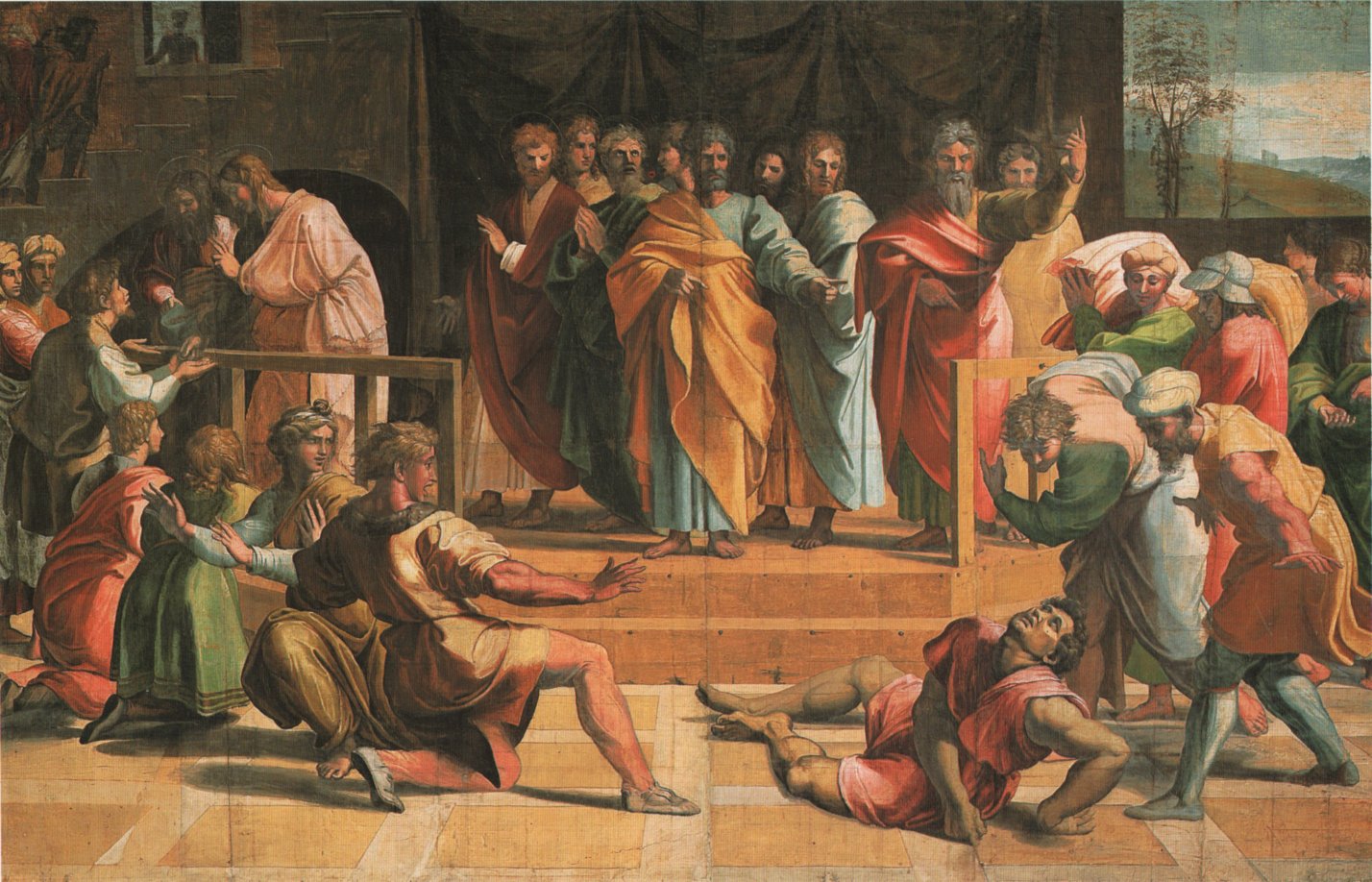
Raphael, The Death of Ananias (1515), Victoria and Albert Museum, London


[For previous installments in this series, see here, here, here, and here.]

Luke, more so than any of the other Evangelists, develops the primitive Christian tradition that the eschatological era inaugurated by the life, death, and resurrection of Jesus would bring with it a radical societal transposition, wherein the rich and powerful would be brought low as the poor, marginalized, and powerless would be exalted. Jesus, as we have seen, programmatically defined his mission in terms of fulfilling the Isaianic promise of proclaiming "good news to the poor" (Luke 4:16-21), introduced his "Sermon on the Plain" by pronouncing blessing on the poor and woe on the rich (Luke 6:20-26), and drove his point home with the powerful parable of "Dives" and Lazarus (Luke 16:19-31).

But what difference do Jesus' counterintuitive pronouncements make concretely for the life of his followers? Are they, as I was implicitly taught in my youth, merely to be "spiritualized" and/or relegated to some future instantiation of the kingdom on earth (i.e., the "Millennium"?), thus allowing disciples to go on living in the present as if Jesus had never uttered these logia? My hunch is that most American Christians, if they have even bothered to consider these texts seriously at all, would tacitly agree with such a proposal, even if they might experience a passing twinge of guilt in the process. To do so, however, would be a mistake. And the places to look for a better alternative are two oft-(willfully) misunderstood texts in Luke's sequel to his Gospel. I am speaking of the two passages in which Luke describes the practices of the early Christian community in Jerusalem, in both of which he speaks of the believers' practice of a community of goods. The texts read as follows:
Those who accepted his message were baptized, and about three thousand were added to their number that day. They devoted themselves to the apostles’ teaching and to fellowship, to the breaking of bread and to prayer. Everyone was filled with awe at the many wonders and signs performed by the apostles. All the believers were together and had everything in common. They sold property and possessions to give to anyone who had need. Every day they continued to meet together in the temple courts. They broke bread in their homes and ate together with glad and sincere hearts, praising God and enjoying the favor of all the people. And the Lord added to their number daily those who were being saved. (Acts 2:41-47, NIV)
All the believers were one in heart and mind. No one claimed that any of their possessions was their own, but they shared everything they had. With great power the apostles continued to testify to the resurrection of the Lord Jesus. And God’s grace was so powerfully at work in them all that there were no needy persons among them. For from time to time those who owned land or houses sold them, brought the money from the sales and put it at the apostles’ feet, and it was distributed to anyone who had need. Joseph, a Levite from Cyprus, whom the apostles called Barnabas (which means “son of encouragement”), sold a field he owned and brought the money and put it at the apostles’ feet. (Acts 4:32-37, NIV)
These two texts fit somewhat awkwardly with the presumed worldview of most Western, especially American, Christians, for whom the church's practice smacks of an unseemly, if not ungodly, "communism." [As an aside, Christian views of socialism, at least in theory, were not always so uniformly negative as might be imagined today. Witness the nuanced discussion of the great Cambridge New Testament scholar and Bishop of Durham, Brooke Foss Westcott, here.] Thus in my undergraduate days at a very conservative Bible College I was explicitly taught that the earliest community's practice was not only not normative for the church's practice today, it was demonstrably an empirical failure. Indeed, my teachers considered this "mistake" on the part of the apostles to be the reason the Jerusalem church was "poor" and in need of famine relief 13 or so years later in 46 CE (Acts 11:27-30) and the Apostle Paul's famous "collection" for them, which he delivered a decade or so after that. Indeed, the presumed "loss of capital" incurred by this practice is blamed as the most probable cause for the Jerusalem church's subsequent poverty by no less an exegete and historian than I. Howard Marshall (Luke: Historian and Theologian [Grand Rapids: Zondervan, 1970] 208).

A little reflection, however, should cause one to realize that such a notion undercuts the transparent purpose of Luke's accounts. Luke, after all, wrote his work long after the Jerusalem church's poverty had become entrenched and Paul, his hero, had delivered the collection from his mostly-Gentile church plants throughout the Empire. Yet he still presents the primitive community's practice in a positive light. Indeed, the early chapters of Acts read like an episodic history, with summarizing paragraphs like those found in Acts 2:41-47 and 4:32-37 serving as "strings" connecting the "pearls" of the individual episodes in which the acts and words of the early apostles that dominate the narrative are recounted. Theologically, these "strings" serve the purpose of demonstrating the consequences of the apostles' words and deeds: God was bringing into existence a community of "believers," his new "saved" people, through the irresistible power of the apostolic message. Not only this, but the "community" aspect of this new people is defined under the rubric of four elements that characterized their life together: devotion to the apostles' teaching, "fellowship" (koinōnia), the "breaking of bread," and "the prayers" (2:42). 

Over the years I have heard countless sermons on this text in which these four elements are stressed as marks of healthy ecclesial praxis. In none of them, however, have I heard the preacher encourage emulation of the community of goods described by Luke in verses 44-45—and this despite the fact that Luke explicitly portrays this community of goods as an expression of the "fellowship" to which the church committed itself in its earliest days. He does this linguistically by means of the adjective koina in verse 44: "And all who believed were together (epi to auto) and would have (eichon [imperfect tense]) all things in common (koina). Here Luke not only describes the earliest church as a society rather than as a group of saved individuals (cf. C. K. Barrett, A Critical and Exegetical Commentary on the Acts of the Apostles, vol. 1: Acts I-XIV [ICC; Edinburgh: T. & T. Clark, 1994] 168), but presents the community of goods as the concrete manifestation of that communitarian perspective in the believers' daily life.


Luke's positive perspective on this primitive practice is, if anything, even more pronounced in the second of his summarizing paragraphs. In verse 33 Luke comments that "great grace was upon them all." At this point the ESV—to cite but one so-called "literal" translation that here doesn't live up to its stated aims—places a full stop and has verse 34 ("There was not a needy person among them") begin a new thought. But such a reading ignores the conjunction gar ("for") which provides the syntactical link between the two clauses. Luke would have us understand that a causal relationship exists between God's favor resting on them and their practice of a community of goods. Indeed, the latter practice provides the warrant for such a claim, and signals God's grace as the impetus for their practice of economic sharing


The ultimate theological significance of this passage, however, may be found in the Old Testament background to the seemingly innocuous introductory words to verse 34. "There was not a needy person among them" (oude … endeēs tis ēn en autois). For this text unmistakenly echoes Deuteronomy 15:4-5, 7-11:

However, there need be no poor people among you (LXX: hoti ouk estai en soi endeēs), for in the land the Lord your God is giving you to possess as your inheritance, he will richly bless you, if only you fully obey the Lord your God and are careful to follow all these commands I am giving you today. ... If anyone is poor among your fellow Israelites in any of the towns of the land the Lord your God is giving you, do not be hardhearted or tightfisted toward them. Rather, be openhanded and freely lend them whatever they need. Be careful not to harbor this wicked thought: “The seventh year, the year for canceling debts, is near,” so that you do not show ill will toward the needy among your fellow Israelites and give them nothing. They may then appeal to the Lord against you, and you will be found guilty of sin. Give generously to them and do so without a grudging heart; then because of this the Lord your God will bless you in all your work and in everything you put your hand to. There will always be poor people in the land. Therefore I command you to be openhanded toward your fellow Israelites who are poor and needy in your land.
The point is a clear one. The early church behaved (the preponderance of imperfect tense verbs in these paragraphs indicate that this practice was a habitual or iterative one that took place over a good length of time) in accordance with a theological understanding of their identity as the eschatological covenant people of God. In other words, the earliest community, as beneficiaries of Jesus' gospel for the poor (Luke 4), saw fit to implement the radical economic costs of discipleship articulated by Jesus during his ministry and thereby embody their claim to be the true people of God.

Of course, as all American preachers and teachers are quick to point out, in contrast to secular socialistic schemes—not to mention similar schemes in Jesus' day, such as that of the Essene sectarians whose literary deposit was discovered at Qumran in 1948 (cf., e.g., 1QS 6:19-22)—the earliest community's practice was entirely voluntary. Barnabas is singled out as an example of the type of relinquishing of property and consequent economic redistribution undertaken by the church (Acts 4:36-37). Ananias and Sapphira, on the other hand, are judged not so much because they didn't give everything, but instead because they lied about the scale of their divestment (Acts 5:1-11). Some Christians, like Mark's mother Mary, retained ownership of her house while using her domicile for the benefit of the community (Acts 12:12-17). And so it has always remained.

To make this observation, however, does not undercut the paradigmatic quality of the earliest community's actions. Nor does it excuse the contemporary American church of its economic obligations toward the poor in its own communities. New Testament scholars have long bemoaned the persistence of crassly individualistic notions of being the people of God in the American church. Some worldviews indeed are very hard to eradicate or even modify. But we as the people of God must never forget who we are—the eschatological people of God, the foretaste of that full ingathering that will populate the promised new earth—and what that means for how we are to implement the social transposition announced by our Lord. For some of us that will entail looking at the poor with a new set of glasses, Christian rather than American in focus. For others, most of us I suspect, that will involve a renewed appreciation for the economic implications of following the One who pronounced blessing on the poor. May the Spirit work to effect this transformation of how we understand ourselves and the times in which we live. Soli Deo Gloria!

Monday, May 20, 2013

Theologian and Preacher Doppelgangers, Part 2


Back by popular demand, here are more theologians, biblical scholars, and preachers and their look alikes in the wider world.


1. R. C. Sproul (Systematic Theologian, Ligonier Ministries)/Sandy Baron (Actor, played Jack Klompus on Seinfeld [d. 2001])

(image@spurgeon.wordpress.com)


(image@theshinguardian.com)


2. Clark Pinnock (Professor of Theology, McMaster Divinity College [d. 2010])/Bill Nighy (English Actor)

(image@thomasjayoord.com)
(image@celebritiesfans.com)


3. Rudolf Bultmann (Professor of New Testament, University of Marburg [d. 1976])/Walter Cronkite (Anchor, CBS Evening News [d. 2009])

(image@babydogmatics.blogspot.com)

(image@newsbusters.org)


4. Martin Luther King, Jr. (Civil Rights Leader [d. 1968])/Bo Jackson (Heisman Trophy Winner; Running Back, Los Angeles Raiders; Outfielder, Kansas City Royals)


(image@spokeo.com)


(image@biography.com)


5. Judith Gundry (New Testament Professor, Yale Divinity School)/Kristin Scott Thomas (English-French Actress)

(image@divinity.yale.edu)


6. Richard Averbeck (Professor of Old Testament, Trinity Evangelical Divinity School)/Jason Alexander (Actor, "George Costanza" on Seinfeld)


(image@evangelicalexegeticalcommentary.com)
(image@ibtimes.com)


This next one comes courtesy of my old pal, Bob Crouse:

7. Ann Graham Lotz (Evangelist; daughter of Billy Graham)/Cindy McCain (wife of Senator and former Presidential Candidate John McCain)

(image@re-vived.com)
(image@hubpages.com)


8. John R. W. Stott (Anglican Cleric, Rector of All Souls, Langham Place, London, Chaplain to Queen Elizabeth II [d. 2011])/Bill Maher (Anti-Religious Agnostic Comedian, Political Commentator, Writer and Producer of Documentary Religulous)

(image@rogersteer.com)
(image@en.wikipedia.org)


9. Dale C. Allison, Jr. (Professor of New Testament, Pittsburgh Theological Seminary)/Richard Harris (Irish Actor [d. 2002])

(image@bakerpublishinggroup.com)
(image@celebrone.com)


10. John F. Walvoord (Professor of Systematic Theology, President, Dallas Theological Seminary [d. 2002])/John Gielgud (English Actor [d. 2000])


(image@mediacenter.tyndale.com)
(image@chacha.com)


11. T. W. Manson (Rylands Professor of Biblical Criticism and Exegesis, University of Manchester [d. 1958])/Henry Travers (English Actor, "Clarence" in "It's a Wonderful Life" [d. 1965])


(image@enriqueta.man.ac.uk)
(image@antiques.about.com)


12. Philip Yancey (Author; Editor, Christianity Today)/Phil Spector (Record Producer and Songwriter; Convicted Murderer)

(image@faithwriters.com)
(image@the citrusreport.com)


And now, two of my oldest, most accomplished, and closest friends, both hailing from the great Philly area:

13. Herbert W. Bateman, IV (Professor of New Testament, Grace and Southwestern Baptist Seminaries)/Steve Buscemi (Actor)


(photo by author)


(photo@zimbio.com)


14. James F. "Putter" Cox (Pastor, Hamilton Bible Fellowship, NY; Chaplain, Colgate University)/Jonathan Goldsmith, "The World's Most Interesting Man" (Actor)


(photo by author)

(image@policymic.com)