Monday, July 9, 2012

Reflections on the End of the Phillies' 2012 Season


Hunter Pence colliding with third base coach Juan Samuel,
7 July 2012 (photo @the700level.com)


Today is July 9, 2012.  I would like to declare it to be the official end of the Philadelphia Phillies' 2012 campaign.  Perhaps this post can serve as something of a (temporary) Declaration of Independence of sorts from the emotional roller coaster that has always accompanied Philadelphia fandom.  I'm not optimistic about that possibility, however.  The bond between this aging sports fan and his Philadelphia teams is unbreakable.  'Til death us do part, indeed.

Of course, the official National League schedule has the Phillies playing until an October 3 game in Washington against the Nationals.  And columns in today's Philadelphia papers by Phil Sheridan and the great Bill Lyon persist in speaking of the all-star break as the close of the "first half" of the season (and the less said about the mindless cheerleading by broadcaster Tom McCarthy, the better).  But who is kidding whom?  Anyone who has watched this team play surely has noticed the second division body language emanating from the dugout, not to mention the second-rate baseball intelligence manifested by players, coaches, and manager Charlie Manuel.  There is simply no way that this team will recover and make the playoffs this season, let alone win their rejuvenated division for the sixth consecutive season. (If they do, I promise  to be more forthcoming in issuing a mea culpa than Bill O'Reilly has with regard to the Supreme Court's handling of the ACA).

Anyone with a modicum of baseball knowledge and acquaintance with the team's injury situation had reason to be fearful about this season.  Many of us vainly tried to calm our worries by "logically" pointing to the pitching triumvirate of Roy Halladay, Cliff Lee, and Cole Hamels, considered by most Philadelphians to be "aces" (for illustrations of what real aces could do, see here).  Indeed, I even suggested that hope could be had in considering the 1965 Dodgers, an offensively anemic club who snuck past the offensively formidable Giants on the arms of Sandy Koufax, Don Drysdale, and Claude Osteen.  Even then, I had the nagging feeling that I was simply trying too hard to overcome my native and enculturated Philadelphia pessimism.  Three months later the depths of my delusion are painfully obvious.  Eighty-seven games into the 2012 season, a number of truths about the Phillies are self-evident:

1.  The Phillies are not in last place primarily because of injuries.

Yes, the injuries to Chase Utley (11 games played), Ryan Howard (3 games played), and Roy Halladay (11 starts) have hurt greatly.  Great teams, however, are able to overcome injuries.  The Dodgers are currently in first place despite their Willie Mays reincarnation, Matt Kemp, having been limited to 36 games.  Even more to the point, the 1963 Yankees won the pennant despite their best players, Mickey Mantle and Roger Maris, being limited to 65 and 90 games, respectively.  To gauge how much these two sluggers were missed, consider that in their combined 484 at bats, the M&M boys hit 38 homers, scored 93 runs, and drove in 88.  Howard and Utley, at this stage of their careers, are simply not players of that caliber. 

Utley, from 2006-2009, was arguably the best overall player in baseball.  Even by that time, however, perceptive observers would have noticed a drop-off in his performance, though the excessive secrecy that has characterized Utley's relation to the public was at work even then in hiding the severity of his physical issues.  His best season was 2007, when he hit .332 with 48 doubles, 22 homers, and 103 RBI despite being limited to 132 games because of a broken hand courtesy of  Washington's John Lannan.  For the first 59 games of 2008, he was even better: .320 with 20 homers and 50 RBI.  Then he fell off significantly, hitting only .275 with 13 homers in his final 100 games that season.  That off-season, he had major hip surgery which, in hindsight, he should have undergone as soon as he was aware of the problem.  In 2009, though Utley's numbers still were good (31 homers, .282 average), he was clearly not the same hitter.  He adapted to make use of Citizen Bank Park's criminally short fences, but the ball didn't jump off his bat as it previously had; as a result, he was far from the gap-hitting doubles machine he had previously been.  Subsequent years have been marked by a progressive decline.  Last year he hit .259 with only 11 homers in 398 at bats, and in his first 11 games this year (in which the team has a 1-10 record!), he has batted at a mere .235 clip.  This is very sad.  Chase was my favorite player on the 2008 World Series team, but any evaluation of his abilities and potential impact must at least try to banish such subjective factors from the discussion.  Utley is, in my view, this generation's Don Mattingly, a hall-of-fame talent whose path to Cooperstown was cut short by injury.  He is, however, done.  Or so it would appear to me.  Any fan (or general manager, and that means you, Ruben Amaro, Jr.) expecting a return to the old days with Utley is simply living in self-delusion.

Howard, who in his first full season (2006) hit .313 with 58 homers and 149 RBI (at the ripe old age of 26, but that's a story for another time), has steadily gone downhill ever since, especially after his weaknesses were exposed for all the world to see in the 2009 World Series.  Last season, the hulking first baseman hit 33 homers and drove in 116 runs, but only slugged .488, a far cry from his .659 in 2006.  Coming off Achilles tendon surgery, did anyone seriously believe he would come back this season, if ever again, in 2006 (or even 2009) form?

The injuries to Utley and Howard have hurt, but we kid ourselves if we think they are the second comings of Joe Morgan and Lou Gehrig.  Perhaps the real measure of their value came in the form of attitude, for their absence has certainly exposed the lack of clothes worn by their previously royal teammates.  Again, however, this should have come as no surprise to any more-than-casual fan.  A perusal of my facebook posts (often a humiliating experience!) over the past two summers confirms how my own frustration with the team's drawn-out periods of offensive ineptitude often bubbled to the surface.  They would go for games being unable to hit with runners in scoring position, but then would explode for 10 runs after building a comfortable lead (i.e., when the pressure was off).  This season it has gotten even worse.  After 87 games, the team still has a total of zero wins in games when it was behind in the 8th inning.  It has a grand total of two walk-off victories, both in games where they had blown an earlier lead.  Hunter Pence, despite his superficially fine statistics (16 HR, .285 BA), has been abysmal with runners in scoring position.  In 106 at bats, he is hitting but .226 with 3 homers.  With two outs and runners in scoring position, he has been even worse: 47 AB, 1 HR, .213).  Sad to say, but I would maintain that the only players carrying their weight have been catcher Carlos Ruiz (who is playing like Pudge Rodriguez in his prime) and surprising leftfielder Juan Pierre. 

Whatever the cause of the team's malaise, it cannot be wholly attributed to the injuries suffered by its best players.  Indeed, I attribute it to two factors.  First, the current edition of the Phillies has a very low baseball IQ.  Pence, for all his hustle, is one of the worst offenders, both wildly swinging at pitches over his head and threatening to play rightfield like Jose Canseco (I wouldn't be surprised one day to see him head a ball over the fence for a homer).  But no one surpasses supposed mainstays like Shane Victorino and Jimmy Rollins in this regard.  Neither has any plate discipline whatsoever, and both somehow imagine that a couple of homers means they are Ernie Banks and Willie Mays, leading to prolonged slumps filled with harmless pop flies.  Both of them need to heed the advice of Dirty Harry Callahan: "A man's got to know his limitations."  Both clearly don't.

More importantly, and I don't make this accusation lightly, is that the team's struggles this season are due even more to the its collective heart or, to be more precise, its lack of one.  Baseball is a cruel game in which luck often determines outcomes.  That is why the 162 game season is so crucial and often a better barometer of greatness than any short series of games.  What proves to be the measure of a player's heart is how he responds to the adversity the game delivers in hefty doses.  Thus far the Phillies have dealt with their adversity very poorly indeed.  One would hope that the size of the players' contracts hasn't come into play here, but the unmistakable feeling I get when watching them is that the all-consuming fire in the belly to win simply is not there.  And that is inexcusable.

2.  The pitching staff has thus far failed to uphold its end of the bargain.

This was always to be the Phillies' strength.  They were down one "ace" from 2011 (as if "John Deere" Roy Oswalt deserved that label), to be sure.  But surely, so the conventional wisdom was, Halladay, Lee, and Hamels would prevent the type of fall from grace we have witnessed this year.  But, of the three, only Hamels (10-4, 3.20) has come even remotely close to expectations.  Halladay, of course, has been shut down because of a strained shoulder, the effects of which had been evidenced by decreased velocity and effectiveness dating back to Spring Training in Clearwater.  He promises to be back soon.  Hopefully, his grit and tenacity will wear off on his stable mates.  Lee, however, has been the greatest mystery.  If anyone had suggested before the season that Lee would win his first game in his 14th start, I would have laughed at him to his face.  But so it was.  Of course, this is not all Lee's fault.  After his ninth start, on June 5, Lee had a 2.92 ERA to go along with his 0-3 record.  But, as his tendency to streakiness should have caused us to expect, an abysmal June led to his current 3.98 ERA: not terrible, but not good, either, certainly not worthy of his annual $20 million paycheck. 

The big fallacy involved in this naive trust in three "aces" is the simple fact that starting pitchers, especially "aces," do not have the same effect on games they once did.  There are no Koufaxes, Marichals, or Carltons pitching today who pitched every 4th game and demanded they finish the games they started, thus lessening the possibility that shaky middle relievers and "set up men" would ruin a well-pitched game by the starter.  The Dodgers of 1965, for example, got 336, 308, and 287 innings from their "big 3."  By contrast, last year's Phillies, whose 102 wins were entirely attributable to the work of Halladay, Lee, and Hamels, got 233.2, 232.2, and 216 innings out of its "big 3."  Where do all those extra innings get allocated?  Well, to such substandard starters as Joe "Plankton" Blanton and Kyle Kendrick, and to a revolving door of AAA-level relief pitchers, that's who.

That is quite simply the point.  If they played by same conventional wisdom as they do today, with 5-man rotations, closely monitored pitch counts, and clearly defined relief roles, the 1965 Dodgers never would have finished ahead of Mays's Giants, Clemente's Pirates, Robinson's Reds, or Aaron's Braves.  But they didn't, and thus they did, receiving 56 complete games from the "big 3," 47 from Koufax and Drysdale alone.  Moreover, the bullpen they did use was effective precisely because they were used differently from how relievers are today.  Ron Perranoski, the unquestioned leader, saved 17 games, but threw 105 innings in his 59 appearances.  Bob Miller saved 9 games while pitching 103 innings in his 61 appearances.  Six other pitchers had saves, including both Koufax (2) and Drysdale (1). 

The Phillies' bullpen arguably has been its weakest link, like a squeaky, out-of-tune second violinist in an otherwise admirable orchestra.  The ERAs of the Phils' relievers tells it all: Papelbon, 3.34; Diekman, 3.57; Schwimer, 3.60; Valdes, 3.80; Qualls, 4.60; Herndon, 4.70; Contreras, 5,27; Bastardo, 5.34; Savery, 5.87; Stutes, 6.35; Sanches, 8.53; Rosenberg, 23.14.  The upshot?  The Phillies' bullpen has the second highest ERA of all major league teams.  It doesn't matter if a starter pitches 6 or 7 shutout innings.  No lead is safe with these stiffs in the pen.  Adding to the insult is that the only major league-quality reliever on the roster, Jonathan Papelbon, has failed to be used in a number of situations by manager Charlie Manuel because they weren't "save" situations.  The result, every time, was a Phillies loss.  I ask: in a tie game in the 9th or 10th inning, would you rather have Joe Savery or Jonathan Papelbon pitch?  Here is one instance where the inanity and worthlessness of the "save" as a statistic has had a deleterious influence on game strategy and the fortunes of the club. 

3.  It is past time for change in both the front office and in the team's managerial and coaching staffs.

All Phillies fans are seemingly in agreement on this one.  Charlie Manuel obviously played a big roll in the startling rise of the Phillies to powerhouse status in 2007 and subsequent years.  His style was the direct opposite of Larry Bowa, whose fiery prickliness had been the scourge of the team's underachievers for years. Particularly with a young roster, Manuel's quiet, encouraging ways and loyalty to "his guys" payed off big time.  But things have changed.  Manuel's "guys" have seemingly aged poorly and prematurely, and many have received hefty salaries that made them impervious to change, even were Charlie to suggest it.  And Manuel's stubbornness has been exacerbated by his obvious deficiencies in terms of game strategy.  Hitting coach Greg Gross has improved no one's hitting, and has positively hindered the development of former phenom Dom Brown, currently languishing in AAA Lehigh Valley.  The same goes for pitching coach Rich Dubee, whose only accomplishments I can think of involve "coaching" his hurlers onto the disabled list.  Pride of place, however, must be given to third base coach Juan Samuel.  Never in my 49 years of following baseball have I witnessed a coach so inept at determining whether or not to send a runner home.  But the coup de grâce had to be Saturday's game against the Braves, when Samuel got in the way of Hunter Pence as the latter was attempting to score.  I can think of no better Keystone Cops routine to summarize this lost season.

The one whose head needs to roll first, however, is General Manager Ruben Amaro, Jr.  Amaro's condescending manner is irritating enough, but he must be judged by his work.  And on this alone he must be judged a colossal failure.  He inherited the 2008 World Series champions, and in only four seasons has turned them into a last place team with the highest payroll in the National League because of cripplingly disastrous contracts to players such as Ryan Howard, Cliff Lee, and Jonathan Papelbon.  Amaro resolutely failed to consider the declining production of Utley and Howard.  To land Halladay and Lee he emptied the farm system of almost all its best prospects.  He spent $50 million on a closer (Papelbon) who is a glorified Mitch Williams.  And, worst of all, he did nothing to enhance the roster of a team he knew would be without at least its best hitter for much of this season (unless one counts the addition of such hulking, one-dimensional players as Ty Wigginton, Laynce Nix, and Jim Thome as something, which I don't).

It's time to clean house.  Sure, the team might rebound next season with a winning record, but without major restructuring, will never come close to winning another series.  Better to start sooner rather than later.

Saturday, July 7, 2012

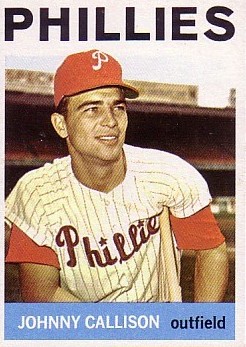
Remembering Johnny Callison


July 7, 1964, Flushing, Queens, New York. One of the best days of the year for a sports-crazed Philly boy:  the 34th Major League All-Star game, played in Shea Stadium during its inaugural season. 

It was in the spring of 1964 that I began, not only to play baseball (soon to be followed by football and basketball), but to follow the game in earnest.  This was the era of Mickey Mantle and Willie Mays, the two megastars seemingly joined at the hip ever since their debuts, at the ages of 19 and 20 (did you catch those ages, Ruben Amaro, Jr.?), in 1951.  My dad, having grown up in East Orange, New Jersey, was a long-time Yankees fan.  He told my brother and me that Mays and Mantle were the two best players in the game.  My brother took Mantle for his hero.  I, noting Mays's 12 home runs and .478 batting average after 22 games on May 12, opted for the Say Hey Kid.  My mom, on the other hand, though from Oklahoma, faithfully listened to the Phillies every evening, and I joined her, marveling at the exploits of rookie Richie (later, Dick) Allen, pitcher (and later Senator) Jim Bunning, and fellow Oklahoman, 25-year old rightfielder Johnny Callison.

The Phillies started well, and for most of the summer were involved in a two-team battle with Mays's Giants for the National League lead.  On July 5, Dennis Bennett outdueled the great Juan Marichal, 2-1, to give the Phils a 11/2 game lead over the Giants and a 47-28 record.  In the All-Star game two days later, Bunning acquitted himself well, shutting out the AL stars in the 4th and 5th innings, while striking out 4.  Phillies southpaw Chris Short, on his way to a 17-9 record with a minuscule 2.20 ERA, was shelled in the 6th, however, giving up a two-run triple to Brooks Robinson.  By the time the National League came to bat in the bottom of the 9th, they were still down, 4-3, and had the apparent misfortune of having to face the Red Sox' intimidating relief ace, 6'6'' Dick "The Monster" Radatz.  Mays led off the inning by working a walk, stole 2nd, and scampered home on a bloop to right by Orlando Cepeda.  The game remained tied until Callison came to the plate with two on and two out.


Note the size of Shea's outfield compared to
today's bandboxes


The National League had Mays, Hank Aaron, and Roberto Clemente (all found greeting Callison at home plate) on the roster, and was so stacked with talent that Frank Robinson didn't even make the team.  Yet it was the Phillies' Callison who won the game with his walk-off laser to right, joining a couple of pretty good hitters named Stan Musial and Ted Williams as the only three ever to do that in a midsummer classic.  Johnny, the unquestioned fan favorite in Philly, was on top of the world.


Callison mobbed at home plate after his game-winning homer


 Callison with Willie Mays and winning pitcher Juan Marichal
following the game


The Phillies continued to dominate throughout the rest of the summer.  On September 20, after defeating the disappointing Dodgers, 3-2, they stood at 90-60, 61/2 games ahead of the second place Cardinals.  What then happened is the stuff of infamy, which to this day has left its indelible mark on this Phillies fan's sports psyche.  As a result of the team's historic collapse, Callison, who hit 31 homers, scored 101 runs, had 104 RBI, with 30 doubles, 10 triples, and a league-leading 20 outfield assists, finished second to the pennant-winning Cardinals' third sacker Ken Boyer for the MVP award.  Callison would have one more monster season for the Phils in 1965 before the unexpected and mysterious precipitous decline that would characterize his last 8 seasons.  On the strength of his outstanding 1962-65 seasons, however, he still managed to retire with 226 homers and a .264 average, and remains one of the best, and certainly the most loved, rightfielders in Phillies history.


When my family moved from the city to Havertown in October of 1964, I had no idea we would be moving to within a half-mile from where Callison lived.  After spending his last four big league seasons in Chicago and New York, Callison returned in retirement to the north Philadelphia suburb of Glenside, where he would live the remainder of his days until his death, in October of 2006, at the too-young age of 67.  Ballplayers in the game's Golden Era were not outrageously compensated, and so Callison had to earn a living tending bar in his retirement.  But he always was approachable and down-to-earth until the very end (read newscaster Brian Williams's reminiscences here).  All these many years later, the name Johnny Callison never fails to bring a smile to my face.  To me he is still here smashing homers into the North Philadelphia night and gunning down foolhardy runners after fielding the ball off that massive 50-foot high corrugated metal right field wall at old Connie Mack Stadium.  I may be getting old, but memories of Johnny keep me from feeling that way.


Left: 1964 Topps Card; Right: 1966 Topps Card with the late Wes Covington

Friday, July 6, 2012

Some Reflections on the "Sinner's Prayer"

It appears that the Southern Baptists have, despite their decidedly nonconfessional ethos, become the new Presbyterians.  Conservative Presbyterians, after all, have their hoary Westminster Confession of Faith, which denominations like the PCA have painstakingly exegeted in order to dispel controversy precipitated by such perceived doctrinal threats as the New Perspective on Paul and the Federal Vision (whether or not they have been quite as successful in exegeting both Scripture and the writings of those they perceive as threatening the doctrinal purity of the church is another matter entirely).

The Southern Baptists, it seems, have their own issues and "traditions" they hold dear.  How else does one explain the recent hand wringing of "traditional" Southern Baptists over the recent ascendancy of Calvinism in the denomination?  Even more recently, prominent denominational leaders, led by Eric Hankins, Pastor of the First Baptist Church of Oxford, Mississippi (and previously the author of the aforementioned screed against Calvinism), successfully presented a resolution on the so-called "Sinner's Prayer" that was adopted at last month's annual convention.  Why the kerfuffle?  The young and Calvinist pastor of The Church at Brook Hills in Birmingham, Alabama, David Platt, had had the temerity to question the validity and ultimate effectiveness of the "Sinner's Prayer," labeling it "superstitious" and criticising its standard use of such nonbiblical expressions as "accept Jesus into your heart" and "invite Jesus into your life."  Hankins, for his part, thinks he knows why Platt and other like-minded preachers don't like the prayer: "The real problem that the New Calvinists have with the Sinner's Prayer is that they believe only certain people can come to faith, and they don't want the hopelessly condemned thinking they are saved or joining churches when they actually have no chance for life in Christ."

Leaving aside the question as to how such abject theological ignorance could characterize the pastor of such a prominent church, it is nonetheless true that Hankins has hit upon the real reason Platt has concerns about the prayer: overreliance on the sinner's prayer breeds false assurance and unintentionally fosters unregenerate church membership.

For those who are not assimilated to the evangelical ethos, the so-called "Sinner's Prayer" is the staple of classic evangelistic methodology.  It includes three, and sometimes four, elements: the admission that one is a sinner deserving of hell, confession of one's inadequacy to save oneself by good deeds, an expression of trust in Christ as personal savior by virtue of his death on the cross, and (in most versions) a pledge to obedience, often in the form of an acknowledgement of Christ's "Lordship" over one's life.  In some versions of conservative evangelicalism, the expression of "faith" or "trust" in Jesus is articulated in terms of "asking Jesus into one's heart" (based on Rev 3:20).  In others, such as the circles in which I was raised, the element of Christ's "Lordship" is lopped off as a subsequent stage of one's Christian discipleship because its inclusion would supposedly introduce the element of "works" into salvation, as it were, through the back door.  In large group settings, such as evangelistic rallies, the "Sinner's Prayer" is often enhanced by the added element of "walking the aisle" or raising one's hand to bring home the element of "decision" inherent in the classic evangelical understanding of conversion.

Let me be entirely clear.  There is nothing intrinsically wrong with the "Sinner's Prayer" so long as its purpose and limitations are carefully understood.  The prayer may indeed facilitate the sinner and would-be convert's mental focus on some of the basic truths of the gospel, thereby reinforcing the noetic content of the message and impressing her sense of individual responsibility before God to respond to the message.  Nevertheless, I stand with Platt and others who have voiced legitimate concerns with the prayer.

1.  There is no Scriptural warrant for the "Sinner's Prayer."  This in itself is not fatal.  Nevertheless, a number of considerations give one pause.  Never do we see Jesus or the apostles encouraging people to pray so as to be "saved."  Even worse is the emotionalistic, pietistic emphasis on "asking Jesus into one's heart" that is part of the legacy of Revivalism.  As I have written elsewhere:
What is first of all evident is that the New Testament never uses the language of "opening the doors of the heart" in connection with "conversion." The evangelistic sermons in Luke's Acts of the Apostles are very clear. What one must do to be saved is "believe on the Lord Jesus" (Acts 16:31). Alternately, one must "repent and be baptized in the name of (the crucified, resurrected, and exalted Lord [Acts 2:22-36]) Jesus Messiah (Acts 2:38), which amounts to the same thing. Baptism was (and is—"sacramentophobia" was less a characteristic of the nascent church than it is of many strands of modern evangelicalism) important because it was the specific, public concretization of (inward) faith (cf. Acts 8:36, 38; Rom 10:9-10). At one's baptism the new believer confessed ,"Jesus is Lord" (Rom 10:9; 1 Cor 12:3), thereby placing him- or herself under the active Lordship of the resurrected Christ and initiating the life of cruciform discipleship demanded so often by Jesus himself (e.g., Matt 10:38). The language of conversion in the New Testament is uniformly that of faith, repentance, confession, and commitment.
The "Sinner's Prayer" presents one way of articulating the key elements of repentance and faith, but fails entirely with regard to the elements of baptism and its concomitant confession.  It thus, whether intentionally or not, promotes the notion of privatized faith that, more than anything else, has worked to undermine the inherently community-based structure of the church.

2.  The "Sinner's Prayer" often functions as a superstitious formula that skews the focus of faith and provides an inadequate basis for assurance.  I know this firsthand.  As a youngster I was exposed consistently to the Bible and worship at both my family's home church and the various churches where my father preached at least a couple of Sundays a month.  I attended the wonderful Calvary (Lutheran) Christian Day School in Havertown where I received fine religious instruction from future LCMS Pastor John Kieschnick.  I was an avid reader of the Bible, imitating my parents' practice of underlining select verses from the text.  I was particularly fond of St. John's Gospel because of its deceiving simplicity and its clear promise of "everlasting life" through "believing" in Jesus.  To this day I still remember stopping on the street in front of my house on Balwynne Park Road in Wynnefield Heights, Philadelphia when I was four years old and telling God I believed in Jesus so I could go to heaven.  But when I got to the age of 13 and started classes at church in preparation for baptism, I realized that the pastor of my church, Dr. George Linhart, always used the expressions "accept Jesus as my personal savior" and "trust in Christ as my personal savior."  I noticed my dad did the same thing (they both got their doctorates from the same seminary I later would attend).  This caused me no small alarm, because heretofore I had always used John's language of "believing" and Paul's language of "faith" (I didn't know at the time they were using the same Greek terms).  And when a youth leader at church expressed concern that a friend of mine had said he was a Christian because he had "received Christ" (despite St. John's use of such language in John 1:12), I was very confused indeed.  I soon learned that my understanding of "faith" correlated well with such interpretatations as "accepting Jesus as personal savior," but I also was taught that using such precise terminology was important so as not to obfuscate the so-called "clarity" of the "gospel."  Any talk of repentance, the Lordship of Christ, or (even worse!) baptism was considered a muddying of the waters.  But saying the prayer using the right words, especially if accompanied by such outward signs as raising one's hand at the weekly Youth Ranch meeting, was the sign of true conversion to which a person could always look back for assurance of "salvation."

Now obviously I don't have a problem with precision of terminology.  I am a theologian, after all.  And it is essential that one knows that the Greek terms translated "believe" and "faith" involve trust/dependence on Christ and commitment to him along with intellectual assent to the terms of the message.  Nevertheless, one must insist that it is faith in Christ, not the parroting of precise terminology in a "Sinner's Prayer," that saves.  And assurance of salvation must always be based on the promises of God to those who believe (present tense, as always in John!) in Christ and whose commitment to him is demonstrably not shortcircuited by consequent unbelief or the lure of the "world."  If one wants a "moment" on which to "hang one's hat," as it were, it would be better, with Luther, to point to one's baptism, the sign and seal provided by God that pictures union with the crucified and risen Christ and with his people that the Spirit effects through the faith he inspires.  "Sinner's prayers," after all, are often brought about by homiletical manipulation and fail to reflect the real interior work of the Spirit of God on the sinner's heart.  Such "conversions" are all too often inauthentic, and I have known far too many cases where Christian family members have clung to hope of their loved one's "salvation" because of their having prayed the prayer or walked the aisle.

3.  Reliance on the "Sinner's Prayer" fosters an unbiblical reduction of "salvation" to a past, punctiliar experience.  Once again, I know this from personal experience.  One of the favorite verses of evangelical Protestants is the programmatic Ephesians 2:8: "For by grace you have been saved."  The key verbal expression (este sesōsmenoi) is perfective in force, emphasizing the present state based upon a past action.  The Ephesian Christians were, so Paul says, in the condition or state of "salvation" because of a definitive act of having been "saved" in the past.  And thus, in common evangelical parlance, "salvation" is effectively reduced to a person's conversion experience.  This, no doubt, is the fruit of Revivalism or what I like to call "decisionism."  In many churches, not least those Southern Baptist churches who are so adamant in defending the "Sinner's Prayer," the focus of preaching is often reduced to the proclamation of a conversionist gospel.  And the consequence is that this focus reinforces the dominant impression that what really matters is whether or not a person is "in" or "out."  Hence the perpetual emphasis an the terms of entry and the perennial controversy in some circles over the Pauline teaching on justification.

Yet Paul more characteristically speaks of "salvation" as a present process (1 Cor 1:17; 15:2) or future hope/confident expectation (Rom 5:9; 13:11; 1 Thess 5:8).  Whereas evangelicals today tend to focus on instantaneous conversion and focus assurance of being "in" on that moment, the New Testament rather takes the long view of discipleship, of the believer daily taking up his cross and following the Lord who embodied the cruciform life of service for others.

I wholeheartedly believe in the doctrines of penal, substitutionary atonement and justification by faith.  But, as I have long argued, the "gospel" can not be reduced to the issue of the "spiritual" salvation of the individual (here, here, here, here, here, here, here, and here).  The "gospel" is the announcement of the kingdom of God, the message that God had been faithful to his covenant promises in the life, death, and resurrection of Messiah (King!) Jesus.  The message of the gospel is good news indeed for a lost world, but the point is not simply to secure a spot in the "in," "saved" crowd for individuals.  Furthermore, it is the evangel itself that is God's power, creating faith in the listener, who when she believes is drawn into the story, where she consequently locates herself in the narrative of God's making all things new.  The gospel preacher must, therefore, not merely declare what God offers, crucial as that is.  Sinners dead in their trespasses and sins can do nothing, after all, to raise themselves from spiritual death.  But the preacher must likewise declare what God demands of those who want the benefits of the kingdom.  Jesus is the only savior, by virtue of his representative, vicarious sin-bearing death.  He also is the risen Lord to whom the sinner must submit in cruciform discipleship.  Those of us who preach the gospel had better not renege on our duty to proclaim both of these truths.  We can use a version of the "Sinner's Prayer" if we like, but we had better not attempt a vain emotional manipulation to bring about "conversions."  It would be better, like the apostles, to proclaim the Word faithfully and trust the Spirit to do his work through the message.  We will then find, as Paul and Barnabas did at Pisidian Antioch, that "as many as were appointed to eternal life believed" (Acts 13:48).

Tuesday, July 3, 2012

Why I Don't Celebrate the Fourth of July

I am an American, but I do not celebrate the Fourth of July. Let me be more precise. I gladly accept the day off from work the way the British do their periodic Bank Holidays. Spending time with family and pursuing beloved leisure activities are always to be welcomed. But I simply cannot celebrate the ideological raison d'être of the holiday.


Those who know me will automatically assume the reason is my confirmed Anglophilia. "McGahey," they will say, "even has a Union Jack on the ceiling of his study and pompously pronounces words like 'process,' 'harassment,' and 'controversy' in the British fashion." Well, I must confess to being an Anglophile, like anyone else raised in my family couldn't help but being. Nonetheless, I am hardly so blind or naive. I know my history, and am well aware of the shameful legacy of such British imperial moments as the Opium Wars and the Second Boer War. Kipling may have spoken reverently of the "White Man's Burden," but such philanthropic impulses are just the bright side of the darker, more basic impulses to power that have driven all major world empires, from the Roman to the (de facto) American.


I am also a Philadelphian. My hometown has many virtues as well as faults, but there is no question that what drives the City of Brotherly Love as a tourist destination is its well-preserved buildings — the destruction of more recent Victorian buildings by the NPS in the 1950s in favor of unhistorical grass lots, no matter how scenic, gives the impression of the buildings being preserved in formaldehyde — that played a central role in the American War of Independence. I was schooled to reverence the founders of my country, and unquestioningly accepted what I was taught about the righteousness of the American cause.


One person differed in his opinion: my father. For those who didn't know him, he was not an ordinary man. Raised in an immigrant family from (British) Northern Ireland, he was the first in his family to attend college, wound up earning a doctorate in theology and teaching at Philadelphia College of Bible for 29 years. For years he told me the American cause was not just, but — rebellious teenager as I was — I brushed him off in my youthful arrogance. In the arsenal at his disposal was one paragraph from St. Paul's letter to the Romans. In the long run it was this text that eventually forced me to stop kicking against the goads:

Let every person be subject to the governing authorities. For there is no authority except by God’s appointment, and the authorities that exist have been instituted by God. So the person who resists such authority resists the ordinance of God, and those who resist will incur judgment (for rulers cause no fear for good conduct but for bad). Do you desire not to fear authority? Do good and you will receive its commendation, for it is God’s servant for your good. But if you do wrong, be in fear, for it does not bear the sword in vain. It is God’s servant to administer retribution on the wrongdoer. Therefore it is necessary to be in subjection, not only because of the wrath of the authorities but also because of your conscience. For this reason you also pay taxes, for the authorities are God’s servants devoted to governing. Pay everyone what is owed: taxes to whom taxes are due, revenue to whom revenue is due, respect to whom respect is due, honor to whom honor is due. (Romans 13:1-7, NET Bible)

This text would appear, on the face of it, to be straightforward and clear. Yet a number of various proposals have been offered to mitigate its prima facie force. Some modern writers have proposed that the exhortation is situationally-dependent and hence limited to the socio-political context faced by Paul's Roman leaders. Paul, so it is argued, was naive in his praise of the Roman empire because of the grand treatment he supposedly had received from governmental authorities. Moreover, even though Nero was the emperor on the throne at the time, Romans was written during the early, promising years of his reign, before he became the erratic, anti-Christian despot he is infamous for being (recently, e.g., Christopher Bryan, A Preface to Romans: Notes on the Epistle in Its Literary and Cultural Setting [Oxford: OUP, 2000] esp. 205).


Such an evacuation of the text's force is hardly credible. If there is one thing certain about Paul, it is that he was neither naive about the sinfulness of human nature nor about how Christians should expect to be treated. It was St. Paul, after all, who later reminded his protégé Timothy that "all who desire to live a godly life in Christ Jesus will be persecuted" (2 Tim 3:12). Is it likely that he would have assumed such persecution would only come from private or synagogal sources? Was Paul, of all people, not aware that the Romans brutally executed his Lord and that people who worshipped the "king of the Jews" and whose confession, "Jesus is Lord" (Rom 10:9), implied that Lord Caesar was not, would inevitably receive similar treatment? Was Paul not aware of the Emperor Claudius's expulsion of the Jews (including Jewish Christians) from Rome in (probably) 49 CE "at the instigation of Chrestus" (Suetonius, Life of Claudius 25.2)? Such questions answer themselves.


Another escape was provided by preachers in colonial America. By and large, when Romans 13 was discussed, such preachers believed that Paul was prohibiting rebellion against the institution of government itself (i.e., the promotion of anarchy) rather than individual rulers themselves (cf. the argument of David Barton here). More recent writers have limited the necessity of obedience to instances in which the governing authorities govern justly, i.e., when they act in accordance with how Paul says they should act in verses 3-4 (for a popular presentation, see Paul J. Achtemeier, Romans [Interpretation; Atlanta: John Knox, 1985] 205).


The text, however, will allow for none of these escape hatches. Verses 1-2 could not be more clear. Submission is due to the "governing authorities" (exousiais hyperechousiais). The participle hyperechousiais has comparative force, indicating that the authorities "surpass" the believers to whom he is writing. The reason (gar) for this is that the powers who exist (hai ... ousai) have, like all rulers, received their “authority” from God (ou estin exousia ei mē hypo theou) by specific appointment (hypo theou tetagmenai). Exhibit A in how the Roman Christians were already acknowledging this authority is presented by Paul in verse 6: they were paying taxes (phorous teleite), which was illustrative of their responsibility, as the apostle writes in verse 7 (reflecting the dominical tradition of Matthew 22:21), to “pay everyone what is owed: taxes to whom taxes are due, revenue to whom revenue is due, respect to whom respect is due, honor to whom honor is due.”


Paul provides two motivations for such submission in verse 5. First, they should be in subjection “because of wrath” (dia tēn orgēn). Despite the ESV’s interpretational translation, “to avoid God’s wrath,” this almost certainly is a summary of the authorities’ punishing capabilities illustrated by their “bearing the sword” in verse 4. Secondly, and more fundamentally, Christians are to submit “for the sake of conscience” (dia tēn syneidēsin), their recognition of what God wants them to do. As Doug Moo says,

The “necessity” for Christians to submit to government is therefore no mere practical expedient, a means of avoiding punishment; it arises ultimately from insight into God’s providential ordering of human history. (The Epistle to the Romans [NICNT; Grand Rapids: Eerdmans, 1996] 803)


In the context it is also noteworthy that the apostle’s exhortations are governed by the programmatic exhortation in Romans 12:1-2 for Christians to present their bodies as living sacrifices to God. Such submission to human government is thus part of the “spiritual worship” (tēn logikēn latreian) or “liturgical service” that defines the Christian’s life before God in all human relationships.


I have left the exhortation itself for last because it is the crux of the issue. Christians must, as Paul says, submit (hypotassesthō) to the governing authorities. In the context, this exhortation is not qualified, and indeed the apostle is criticized often for his apparently rose-colored opinion of such authorities (vv. 3-4). A little stepping back for reflection might be in order here. For does not the fact that, of all issues, the apostle devotes a paragraph to the matter of the Christian’s response to governing authorities imply that perhaps there might be a reason not to submit to them? Jesus, according to the basic Christian confession, is “Lord.” This confession thereby deconstructs the pretensions of Caesar. And the belief that the eschatological reign of God had been inaugurated in the Christ event certainly did result in eschatological enthusiasm among some of Paul’s less theologically-sophisticated converts. I would suggest that the purpose (one of them, anyway) of this paragraph was to define the proper Christian response to governing authorities in the interim between Christ’s enthronement and glorious return, when the kingdom, already inaugurated, will be consummated.


Nevertheless, it would be mistaken to assume that such “submission” always entails obedience to the authorities. Paul, to make his basic point, writes of the authorities as God had, in his common grace, designed human government to be. But he of course, as I asserted earlier, wasn’t so naïve. Indeed, the implied qualification is provided by Luke in Acts 5. When the Jewish authorities tried to prohibit the apostles from proclaiming the message of Jesus Messiah, Peter responded, “We must obey God rather than men (Acts 5:29).” There are, as it were, differing levels of authority. Believers, like all people, must place themselves under (hypotassesthō) the ruling authorities, subordinating themselves to their authority. But, as Paul states, these earthly authorities stand under God because they owe their positions to the appointment of God. When conflict arises, believers owe their ultimate allegiance to the highest power, God himself.


Where does this lead us with regard to the issue at hand? Certainly the British crown handled the colonial situation poorly and heavy-handedly. That is not in dispute. What is surprising to me (though it shouldn’t be) is the telling fact that most “patriot” sermons of the period avoided Paul’s exposition in Romans 13, preferring instead to compare the American experience to the Israelites in Egypt prior to the Exodus. In other words, they defended their hoped-for rebellion against “tyranny” by invalidly comparing America to God’s Old Covenant people.


Moreover, despite legitimate grievances against the crown, descriptions of George’s “tyranny” often were characterized by typical polemical distortion. As historian Mark Noll has reminded us, King George himself was a Christian who believed himself acting on Christian principles, no matter how, in hindsight, we can demonstrate that he failed to do so. And, as the theologian John Wesley proclaimed at the time, the colonists themselves had no grounds to complain since they refused to pay taxes and hypocritically refused rights to the African slaves they exploited for their own gain.


The colonists certainly were not simply inventing grievances. The proper question, however, is whether such “tyranny” justified taking up arms to rebel against it. Once again, history has plenty to say on the matter. It is an indisputable fact that the early Christians, even under such brutal regimes as the later Nero, Domitian, and Trajan, refused to take up arms to defend themselves against martyrdom and attempted extermination. Likewise, as Wesley noted, the American colonists, as British citizens, were granted more human rights than almost every other person on the face of the globe at that time (we must always attempt to avoid the bane of anachronism). The Founding Fathers had a better vision, or so they thought (and I would agree), but that in itself does not define “tyranny.” When would-be “evangelical” apologists for the Fathers boldly compare the British crown with Nazi Germany and Stalinist Russia, I can only conclude that one’s thinking has gone off the rails somewhere, most likely at the starting point of one’s assumed metanarrative detailing American righteousness and “exceptionalism.”


The Bible, of course, does not speak of such matters as “just war.” To use the Israelite conquest of Canaan as justification would, of course, be theologically mistaken. Early Christian practice is far more suggestive. As is well known, Christians until the time of Constantine refused to fight in the Roman war machine, despite the pax romana that it engendered. “Just War” theory was developed later as a response to a new set of cultural circumstances by such theologians as Augustine and Thomas Aquinas. Major elements of such theory include the provisions that the war must be defensive, must be waged against a grave evil and as a last resort, must respect the distinction between combatants and ordinary citizens, must have a reasonable chance of success, and must result in a set of circumstances better than what obtained prior to war. Using such criteria, I would argue that the American Revolution, like most of the wars this country has fought (except for WWII), was unjustified. And I am hardly alone in this judgment. As Noll and Messiah College’s John Fea suggest, perhaps the only ones justified to rise up were the black slaves held against their wills by the colonists.


Political grievances do not justify the taking up of arms. Good ideas — and I repeat, the Fathers had many great ideas which had influence both at home and ultimately in the old country —do not demand rebellion against authorities who don’t espouse them. And the desire for more “freedom” did not justify the loss of 27,000 American and 10,000 British lives on the fields of battle. One cannot but help thinking that, in time, the colonies would have gained their independence peacefully as did both Canada and Australia, both of which have kept their commonwealth ties to the crown. That, I suggest, would have been more in keeping with a genuine Christian worldview and submission to the Scriptures evangelicals claim to be their ultimate authority for doctrine and practice.


I am happy to be an American, a citizen of a country that allows me to worship God as I choose and that functions by the rule of (a mostly benevolent) law that I, as a grateful citizen, must submit myself to. Even so, I have to acknowledge that its genesis occurred as a result of what St. Paul would have considered a sinful rebellion against a crown whose authorization to govern ultimately derived from God himself. As much as I admire Thomas Jefferson, I must bow to the authority of St. Paul.


That being said, I can now look forward to those grilled burgers and hot dogs …


Monday, July 2, 2012

Mike Bird on Evangelicals and Health Care

When I opened Facebook this morning I noted an e-mail from my brother.  It simply read as follows:
And he went through all Galilee, teaching in their synagogues and proclaiming the gospel of the kingdom and healing every disease and every affliction among the people." - Matt. 4:23. The first example of universal health care.
As always, the comment was to the point and perceptive.  Jesus wasn't simply performing random "miracles" to "demonstrate he was God."  As a Christian, I believe whole-heartedly that he was indeed "God incarnate."  But the point of these "mighty acts" was more subtle, tied more closely to salvation-history than it was to Christology, let alone "divine" Christology.  Jesus was in the business of inaugurating the long-awaited kingdom of God.  This anticipated royal rule of God was to be the occasion of the reversal of the covenant curse of exile and the concomitant reversal of the curse of Eden itself.  As Isaiah the prophet proclaimed (Isa 35:5-6):
Then the eyes of the blind shall be opened,
and the ears of the deaf unstopped;
then shall the lame man leap like a deer,
and the tongue of the mute sing for joy.
For waters break forth in the wilderness,
and streams in the desert.
Care for the sick should be, as it was for the early Christians, part and parcel of what it means for Christians to implement the kingdom victory won by Jesus on the cross.  If indeed Christians ought to manifest the priorities of the kingdom of God in their political activity and posturing, then one would think care for the health of the poor and marginalized would apply every bit as much as defense of the unborn.  But alas, it does not, if the angry reactionary rhetoric in response to last week's Supreme Court decision on "Obamacare" comes anywhere close to reflecting the mood of American evangelicalism.  Some things manifestly sit higher on the priority scale for such Christians than the plight of the poor.

Providentially (or so it would seem), the first article I read today in my daily surfing of internet blogdom was a post by the Aussie New Testament Scholar Mike Bird, entitled "Evangelicals and Health Care."  He introduces his post thus:
I have to confess to always being perplexed not only by American opposition to universal healthcare, but to opposition to universal healthcare by evangelicals on purportedly theological grounds. I was simultaneously amused and confused by the image on TV of two pastors prostrating themselves before the Supreme Court and praying that Obamacare would be thrown out. Did they really think that God would be opposed to everyone in America having access to healthcare (even if legally required to purchase it)? I thought Jesus went around healing the sick, the blind, and the lame … for free? Didn’t Christians set up the first hospitals in the world? Has anyone heard of the Leprosy Mission and the work they do around the world without asking for a person’s insurance number? So the question is why the opposition to universal healthcare and why is the conservative evangelical constituency among the most vocal in opposition to it?
As I am sure comes as no surprise to most who will read this post, I share both Bird's perplexity and dismay at the overwhelming attitude of American evangelicals — thankfully, world-wide evangelicalism takes a very different stance on the matter — toward the matter of universal health coverage.  In particular, I am grieved by comments such as this one, written by a former student of mine:


Supreme court what a joke! I can't wait to pay for health insurance for all the lazy americans that don't have insurance because they are lazy and won't find a job and get off the dole!
Notwithstanding the sheer obnoxious ignorance and self-righteousness of this statement — is it really the case that most people without insurance are in their predicament because they are "lazy" and "won't find a job"? Is it not a scandal to this writer that the USA is the only "advanced" nation in the world where people must often decide between the options of financial ruin or recovery of health? — it illustrates as clearly as one might wish the root cause of the seemingly predominant American evangelical attitude.  At times I ask myself how a "Christian" (St. Paul would say adelphos onomazomenos, "one named a brother," i.e., a "so-called brother" [1 Cor 5:11]) could think, let alone act this way.  Like Paul, however, I end up assuming the best and admonishing them to live in a manner commensurate with the name they profess.

Simply put, the regnant evangelical attitude is caused almost entirely by the assumed American metanarrative in which these people have, wittingly or not, chosen to live.  Americans, more than any other people in the world, have an individualistic worldview.  The myth of the "rugged individual" lives on and thrives in a pride-based political climate that decries a "culture of dependence."  This idea, of course, has a long and distinguished pedigree.  It was Ben Franklin, after all, who coined the proverb, "God helps those who help themselves."  Individualism's progeny are likewise problematic.  For instance, individualism breeds an attitude in which "freedom" becomes the summum bonum of life (this applies, by the way, to people on both ends of the political spectrum; both sides value absolute freedom in clearly circumscribed spheres, yet seek to limit others' freedom in different respects).  Taxes are hated because they represent "giving away my hard-earned money" to "others" who, for one reason or another, don't "deserve" my largesse.  Indeed, government monies devoted to the common good, such as public transportation, the arts, and even public education, are often vilified as "socialist" experiments that ought rather to be eliminated (notwithstanding the sheer ignorance as to what "socialism" involves and the sloppy, slippery-slope logic entailed).  "Community" and "the public good" are categories that hardly receive a second thought from many such ideologues.  And this is not a good thing.

Indeed, as I have argued elsewhere (here and here), such libertarian attitudes betray an unbiblical social Darwinism that cuts against the grain of the biblical demand to love one's neighbor as oneself (Lev 19:18; Mark 12:31 et par.).  It is here that I simply can't get past the stingy meanness of much conservative rhetoric which, if people actually mean it, goes far beyond anything that could claim to conform to Christian standards.

To be clear: "Obamacare" is far from perfect (though, to my mind, clearly constitutional; the "conservative" justices' rejection of its applicability based on the commerce clause is, to my mind, a blatant example of political posturing).  It is certainly unwieldy, and will undoubtedly be a pain in the backside for the lower-middle class because of the lack of a public option.  Worst of all, it still works with insurance companies whose primary concern is not the delivery of health care but the maximizing of corporate profits.  This, I maintain, is an unworkable situation that will never benefit those people who most need help.

But it is past time for critics of "Obamacare" to desist in laying all the blame for the act's unwieldy nature on the President himself.  It is past time for such critics to acknowledge that its major elements, including the loathed "individual mandate," are in fact almost identical to what Mitt Romney enacted in Massachusetts.  It is past time for them to acknowledge that the act's lack of elegance is primarily the fault of the Republicans in Congress who disallowed any plan more amenable to the President's actual legislative preferences.  And it is past time for Christian critics of "Obamacare's" individual mandate to search their souls and admit that the system it is replacing was irretrievably broken and discriminatory against people without either the means to pay or the good luck to stay healthy.  And I don't want to hear about "replacing" Obamacare with a more "market-oriented" solution.  Frankly, "conservatives" have had plenty of time to come up with such a solution.  Until Barack Obama came along, it has not been one of their priorities to do so, because any plausible solution will hit their primary constituencies in the wallet.  And Christians who decry universal healthcare had better come to the realization that their allegiance to Christ by definition puts them on the side of the poor rather than the corporate rich.

In conclusion, I can do no better than to quote Professor Bird, with whom I am in absolute agreement:


The opposition to universal healthcare can only be given religious currency by either repeating the words of Cain, “Am I my brother’s keeper?” or by quoting the apocryphal saying, “God helps those who help them themselves!” It has no traction in the Judeao-Christian ethic, nor in the teaching of Jesus, the instruction of Paul, and has no place in the testimony of the Christian tradition.

Marichal, Spahn, and 16-Inning Complete Games: 2 July 1963 Revisited


Today marks the 49th anniversary of one of the most remarkable games in major league history, the famous 16-inning duel between Juan Marichal of the San Francisco Giants and Warren Spahn of the Milwaukee Braves at Candlestick Park, won 1-0 by the Giants on a walk-off home run by the great Willie Mays, who in the fourth inning had preserved the Dominican's shutout by gunning down Norm Larker at the plate.

No fewer than seven future Hall-of-Famers played in this game — Mays, Marichal, Willie McCovey, and Orlando Cepeda for the Giants; Henry Aaron, Spahn, and Eddie Mathews for the Braves; an eighth, Gaylord Perry, remained salivating, as it were, on the Giants' bench.  It remains the last time any two pitchers have pitched 15 shutout innings in the same game.  Some — Jim Kaplan, for instance — consider it to be  "The Greatest Game Ever Pitched."  Though some, including yours truly, might demur — I still consider the 1965 Sandy Koufax perfect game against the one-hitting Bob Hendley to deserve that accolade — it is surely a set of performances the likes of which we will never again witness.


Game Played on Tuesday, July 2, 1963 (N) at Candlestick Park

MIL N    0  0  0    0  0  0    0  0  0    0  0  0    0  0  0    0  -   0  8  1
SF  N    0  0  0    0  0  0    0  0  0    0  0  0    0  0  0    1  -   1  9  1
 
BATTING
Milwaukee Braves             AB   R   H RBI      BB  SO      PO   A
Maye lf                       6   0   0   0       1   0       3   0
Bolling 2b                    7   0   2   0       0   0       3   4
H. Aaron rf                   6   0   0   0       1   1       3   0
Mathews 3b                    2   0   0   0       0   2       0   0
  Menke 3b                    5   0   2   0       0   1       1   1
Larker 1b                     5   0   0   0       2   0      14   4
Jones cf                      5   0   1   0       0   2       7   0
  Dillard ph,cf               1   0   0   0       0   1       3   0
Crandall c                    6   0   2   0       0   0       5   0
McMillan ss                   6   0   0   0       0   0       4   7
Spahn p                       6   0   1   0       0   3       3   4
Totals                       55   0   8   0       4  10      46  20

FIELDING - 
E: Menke (12).
BATTING - 
2B: Spahn (3,off Marichal).
Team LOB: 11.
BASERUNNING - 
SB: Maye (5,2nd base off Marichal/Bailey); Menke (1,2nd base off Marichal/Bailey).
CS: Crandall (1,2nd base by Marichal/Bailey).

San Francisco Giants         AB   R   H RBI      BB  SO      PO   A
Kuenn 3b                      7   0   1   0       0   0       5   2
Mays cf                       6   1   1   1       1   1       3   1
McCovey lf                    6   0   1   0       0   0       4   0
F. Alou rf                    6   0   1   0       0   0       5   0
Cepeda 1b                     6   0   2   0       0   0      15   1
Bailey c                      6   0   1   0       0   0      12   1
Pagan ss                      2   0   0   0       0   0       1   1
  Davenport ph                1   0   0   0       0   0       0   0
  Bowman ss                   3   0   2   0       0   0       0   2
Hiller 2b                     6   0   0   0       0   0       2   2
Marichal p                    6   0   0   0       0   1       1   3
Totals                       55   1   9   1       1   2      48  13

FIELDING - 
E: Kuenn (5).

BATTING - 
2B: Kuenn (6,off Spahn).
HR: Mays (15,16th inning off Spahn 0 on 1 out).
IBB: Mays (2,by Spahn).
Team LOB: 9.

BASERUNNING - 
SB: Cepeda (2,2nd base off Spahn/Crandall).

PITCHING 
Milwaukee Braves             IP     H   R  ER  BB  SO  HR BFP
Spahn L(11-4)                15.1   9   1   1   1   2   1  56
IBB: Spahn (2,Mays).
San Francisco Giants         IP     H   R  ER  BB  SO  HR BFP
Marichal W(13-3)             16     8   0   0   4  10   0  59

Umpires: HP - Ken Burkhart, 1B - Chris Pelekoudas, 2B - Frank Walsh, 3B - Jocko Conlan
Time of Game: 4:10   Attendance: 15921

(Box Score @http://www.retrosheet.org/boxesetc/1963/B07020SFN1963.htm)


The reason I can confidently state this is the staggering pitch count totals amassed by Spahn and Marichal, which serve as pointers to the measures of these aces.  Mays hit his homer on Spahn's 201st pitch.  Marichal, more of a strikeout pitcher and, on this day, wilder than usual (if one wants to call 4 walks in 16 innings "wild"), threw 227 pitches, and was harder to hit in extra innings than he was earlier in the game.  And this from pitchers who regularly worked on just three days rest!

In today's game, pitchers work on four days rest, and hurlers who manage to pitch 220 innings in a season are considered "workhorses."  Roy Halladay, today's premier workhorse, has pitched more than 250 innings just twice in his 15-year career, with a high of 266 innings in his 2003 Cy Young campaign.  In 1963, the 42-year old Spahn, whom I consider the greatest southpaw ever to play the game, pitched 259.2 innings, the 16th time in 17 seasons in which he threw more than 250, the lone exception being 1955, when he threw "only" 245.2.  In those 17 seasons, Spahn won 20 or more games a staggering 13 times.  In 1963, Spahn went 23-7 with a 2.60 ERA, but was "only" the third-best pitcher in the league.

Marichal, on the other hand, was a youthful 25 on his way to the first of six 20-win seasons in the next seven years.  In 1963 he logged 321.1 innings and completed 18 of his 40 starts on his way to a 25-8 record and 2.41 ERA.  His durability during his prime seasons should be more legenday than it is.  From 1962-71, Marichal threw more than 250 innings every year except for 1967, when hamstring and thigh injuries limited him to 14 victories and 202.1 innings, and 1970, when an adverse reaction to penicillin hampered his effectiveness.  Three times (1963, 1966, 1968) he logged more than 300 innings, missing a fourth in 1969 by a mere 1/3 of an inning.  For his career he completed 244 of the 457 games he started.  In 1968-69, he completed 57 of his 75 starts, including 13 shutouts.  These are numbers simply unimaginable in the baseball of 2012.

Marichal is one of the most underappreciated stars in major league history.  When great pitchers from the 1960s are mentioned, one usually hears the names of Koufax and Gibson, and sometimes even Don Drysdale, mentioned before Marichal's.  Koufax, of course, was the best pitcher of his era — the best pitcher I have ever seen and only rivaled by the Lefty Grove of 1928-33 for short-term dominance.  Gibson, apart from his immortal 1968 season, was great but not nearly at Marichal's level of sustained excellence.  Drysdale, good as he was, does not deserve to be mentioned in the same breath as the other three.  Consider these numbers.  Marichal won 25 or more games three times in a six year period (1963, 1966, 1968).  His 191 victories in the 1960s led MLB.  From 1963-1969, Marichal had a record of 154-65 (22.0-9.3 per season) with a 2.30 ERA, 1505 strikeouts (215 per season), 164 complete games, and 38 shutouts.  He tossed a no-hitter in 1963, led the league in ERA in 1969 and in shutouts in both 1965 (with 10!) and 1969.  From 1962-66 he actually won as many games as Koufax (111), and from 1963-66, Koufax's best seasons, Marichal's 93-35 record, 2.31 ERA and 916 strikeouts are only marginally less impressive than Koufax's other-wordly 97-27 record, 1.86 ERA, and 1228 strikeouts.  Of course, the shadow of John Roseboro looms over Marichal's resume, but that regrettable incident should have no bearing on objective evaluations of his career.

I am aware of the changes MLB has undergone in the intervening decades.  I know the bandbox craze initiated by Baltimore's Camden Yards has proceeded unabated, not least in the otherwise admirable Citizen's Bank Park in Philly and the new Yankee Stadium in the Bronx.  I know about changes in bat technology that have enabled players to wield weapons two ounces lighter than they did back in 1963.  I know the more consistent calling of the high strike in that era allowed pitchers to use the high heat in a way they never could in today's game of rogue umpires who refuse to call the game by the book.

Nonetheless, something is clearly wrong.  Hall-of-Famer Joe Morgan has criticised the now-sacrosanct five-man rotation.  Hall-of-Fame pitchers from Ferguson Jenkins to Nolan Ryan, the latter of whom once threw 244 pitches in a 15-inning game back in 1971, have gone on record criticising the obsessive emphasis on pitch counts that burdens games with scores of relief pitchers who never would have made the team back when they pitched.  When I read fan comments about how "overuse" by the (implied) abusive Charlie Manuel is the cause of Halladay's back and shoulder issues this season, I can only shake my head at their lack of historical perspective and capitulation to unproven conventional wisdom.


Those of us who love baseball and its glorious history, however, can reminisce fondly about games such as the one played in San Francisco on 2 July 1963.  Spahn is long gone, having succumbed to cancer back in 2003.  Marichal, "the Dominican Dandy," is now 74.  The two greatest National Leaguers who ever played, Mays and Aaron, who went 1 for a combined 12 that night, are now 81 and 78, respectively.  Time marches on for us all.  But I will always remember these legends as they were in their prime and my youth, itself but a distant memory.


The heroes that night, Juan Marichal (l)
and the incomparable Willie Mays (r)


1964 Topps Card: Still true,
all these many years later