Saturday, April 13, 2013

Pete Rose after 50 Years

"Charlie Hustle" in classic form
(photo@sportsillustrated.cnn.com)

13 April 1963. Major League Baseball was in reality what it still claims to be: America's National Pastime. Indeed, baseball was in its glory days. I would argue that the years between 1947, when Jackie Robinson broke the sport's abhorrent color barrier, and 1969, when both leagues expanded to 12 teams and the divisional era commenced, were the apogee of the game. White stars like Ted Williams, Stan Musial, Al Kaline, Mickey Mantle, Whitey Ford, and Sandy Koufax were joined by African-American luminaries such as Willie Mays, Henry Aaron, Ernie Banks, Frank Robinson, and Bob Gibson. Added to the mix was a rising tide of Latin American stars like Minnie Minoso, Luis Aparicio, Roberto Clemente, Orlando Cepeda, and Juan Marichal. Never before or since has such an assemblage of talent played on the diamonds of America's great cities of the Northeast, Midwest, and (later) California. It was a time when America's best athletes were drawn more to baseball than they were to football and basketball. I have often wondered whether Mantle and Mays, for example, would have ended up as a running back (Mantle) and cornerback (Mays) instead of the two best centerfielders I ever saw had they been born in 1981 instead of 1931. No doubt they would have, and been immensely successful. I, however, am grateful that they didn't, and that I had the privilege of seeing each of them play the sport for which they were best suited.


Crosley Field, Cincinnati (photo@www.city-data.com)
But in the middle of that charmed era of change sprang an anomaly: a throwback player devoid of the speed of an Aparicio, the power of Mantle, or the all-around brilliance of Mays, a player who harked back to the bête noire of early 20th century baseball, the great Ty Cobb. I am speaking, of course, of Peter Edward Rose who, on this day 50 years ago, garnered the first of his record 4256 hits, an 8th inning triple off of Pirates' hurler Bob Friend in a lopsided 12-4 loss at old Crosley Field in Cincinnati. Rose, like Mays 12 years earlier, had failed to get a hit in his first 12 official at bats (though he did walk in his first plate appearance 5 days earlier, scoring on a home run by Frank Robinson). But once he got that first hit, there was no stopping him. In his first season, he accumulated 170 hits, hit .273, scored 101 runs, and was named the National League Rookie of the Year. 


My first Pete Rose baseball card,
the 1964 Topps
In his third season, 1965, Rose really hit his stride. That year he led the league with 209 hits, batted .312, scored 117 runs, made the first of his 17 All-Star appearances, and finished sixth in the voting for National League MVP. In his peak years of 1965-81, Rose hit over .300 15 times, had 200 or more hits 10 times, and scored more than 100 runs 9 times. He led the National League in hits 7 times, doubles 5 times, runs 4 times, and batting three times. Ten times he finished in the top 10 in MVP voting, winning the award in 1973, a year in which he led the Big Red Machine to 99 wins and the NL West title by hitting .338. By the time he hung up his spikes in 1986 at the age of 45, Rose had amassed 4256 hits, scored 2165 runs, hit 746 doubles, and had a lifetime batting average of .303.

What set Rose entirely apart from his contemporaries, however, was the style of his play. He was certainly not a self-promoting "hot dog." Nor did he play with the panache of Mays or the simple elegance of Aaron. He was emphatically not "cool," as the flat top haircut he sported in the '60s attests. What he was was a hard-nosed player who played every minute of every game as if his whole life depended on it. My earliest recollection of Rose was his anomalous penchant for sprinting to first base when issued a base on balls (a "walk"). Indeed, such behavior led to the scornful nickname "Charlie Hustle," which Rose nevertheless bore as a badge of honor (according to Mickey Mantle, Whitey Ford was the first to dub Rose thus when, on a long homer by Mantle in Spring Training 1963, Rose nonetheless sprinted to the wall and leaped as high as he could to catch the ball even when he had no chance in succeeding at his quest). 


Rose bowling over Ray Fosse in the 1970 All-Star Game
(image@fromdeeprightfield.com)
The dark side of Charlie Hustle reared its ugly head on the night of 14 July 1970 at brand new Riverfront Stadium in Cincinnati. The occasion was the annual exhibition known as the All-Star Game, pitting the stars of the American and National Leagues against each other. With Rose on second and two outs in the bottom of the 12th inning, Jim Hickman singled to center. Rose, against his better judgment, streaked home. As the throw from center approached Fosse, Rose decided against his typical headfirst slide, instead lowering his shoulder and steamrolling youthful Cleveland catcher Ray Fosse as the ball sailed by, separating Fosse's shoulder in the process. Rose's "hustle" guaranteed the National League's 8th straight victory, but his overzealousness was widely criticized as unnecessary in view of the game's status as a mere exhibition. Nonetheless, Rose, as is his wont, remained unrepentant.

Rose's darkest days, however, wouldn't come until the years 1984-89, when he managed his hometown Reds. In 1989, after rumors had circulated for some time, Rose was questioned by Baseball Commissioner Peter Ueberroth and his successor Bart Giamotti about reports that he had bet on baseball, in particular games involving his own Reds team. After an investigation by attorney John Dowd uncovered incontrovertible evidence (despite Rose's persistent denials, which lasted all the way to 2004, when he finally admitted doing so) that Rose had gambled on dozens of Reds games during the years he managed the club. As a result, on 24 August 1989, Rose accepted a lifetime ban from the game he loved from Giamotti. And so he remains a baseball outcast to this day, denied the spot in the game's Hall of Fame he covets more than anything in the world. His story is a true Greek tragedy, his downfall precipitated by a fatal flaw of character that, when channeled properly, made him one of the greatest players ever to lace up spikes.


Rose saving the day in the 9th inning of Game 6
of the 1980 World Series in Philadelphia
(image@sports.yahoo.com)
I have a confession. Despite his obvious and multifarious character flaws, I love Pete Rose. And note that this confession comes from a Phillies fan of 50 years who absolutely hated Rose during his days with the Big Red Machine. The reason for my change of heart was the Phils' signing of Rose in 1979 for a then-record 4-year, $3.2 free agent contract. The Phils had won three consecutive division titles (winning 101 games in both 1976 and 1977), but had faltered each year in the playoffs (in 1976 to Rose's Reds). They had loads of star power, led by Mike Schmidt and Steve Carlton, but Schmidt in particular never seemed to be able to live up to the massive potential he so obviously had.  All this changed with the acquisition of Rose. Rose, for one, had the confidence in Schmitty that Mike lacked: "Mike Schmidt is the best player in the National League today. There's no question about that. He honestly doesn't realize how much ability he has. All he has to do is get the most out of those abilities on a daily basis because, believe me, he can play. He can do it all and he's just starting to want to more and more." The results were immediate: 45 homers in 1979, followed by MVP seasons in 1980-81 in which Schmidt developed into arguably the game's best player. More importantly, however, Rose brought legitimate swagger and confidence to the Phils, leading to the franchise's first World Series title in its then-97 year history. An indelible image etched into the memory of all Phillies fans alive at that time is that of Rose catching Frank White's foul pop in front of the team's dugout after normally sure-handed catcher Bob Boone had dropped it, securing the second out in the top of the ninth of the deciding 6th game at Veterans Stadium in South Philly on 21 October 1980. And never once did I ever see Rose dog it to first on a routine groundout, something I wish I could say about the current denizens of Pattison Avenue.

Does Rose belong in the Hall of Fame? I say yes. His boorishness, past sins, and often pathetic current demeanor must be acknowledged as a matter of public record. But, in my view, he has served his time. Moreover, the Hall is home to two players with convictions for drug offenses (Orlando Cepeda and Ferguson Jenkins). It is home to a pitcher who flagrantly defied the game's rules by throwing spitballs (Gaylord Perry). It is home to former commissioner Kenesaw Mountain Landis who, despite his key role in restoring baseball's integrity after the Black Sox scandal (see below), was an implacable racist who perpetuated the "gentleman's agreement" that kept African-American ballplayers from playing in the Major Leagues (his insistent "concern" for the Negro Leagues that would have been, and ultimately were, decimated by integration ring more than a little hollow in retrospect). Most significantly, it is home to Ty Cobb who, despite being one of the ten best players ever to play the game, was the meanest player of his era and hated even by his own teammates (not to mention a possible perpetrator of manslaughter). [an aside: the Pro Football Hall of Fame has not seen fit to remove O. J. Simpson from its ranks either]. 

The upshot: membership in the Hall of Fame should be based on a man's achievement and historical significance, not his suitability to serve as a societal role model. The explanation for Rose's predicament, of course, goes back almost a century, to the aforementioned "Black Sox scandal," when a number of players for the Chicago White Sox, including superstar Shoeless Joe Jackson, took money to throw games and lose the 1919 World Series to the Reds (for those interested, see Eliot Asinof's fine book, Eight Men Out, or, for those with shorter attention spans, the movie of the same name starring John Cusack). As a result, the game has been extremely sensitive to gambling, and rightly so. Nevertheless—and to me this is the key point—Rose never has been shown to have bet against the Reds (and who that ever saw him play seriously believes he did?). And if he did not, I see no definitive or compelling reason to keep him out, lack of genuine repentance notwithstanding.

One of the thrills of my life was traveling to Cooperstown, New York in July of 1995 to witness the Hall of Fame induction of Phillies legends Schmidt and Rich Ashburn. The field on which the ceremony took place was a veritable sea of upwards of 30,000 people clad in Phillies red, at the time a record-setting attendance for an induction ceremony. Schmidt, in his speech, mentioned that Rose was his grandmother's favorite player. Then, as he is prone to do, he made a controversial pronouncement: "I join her and millions of baseball fans in hoping someday soon, someday very soon, Pete Rose will be standing right here." Of course, the ocean of Phillies fans in attendance roared their approval. Here's to hoping that Michael Jack gets his wish.

Wednesday, April 10, 2013

The Times They Are A-Changin', Part 2: Mary's Magnificat (Luke 1:46-55) [revised 12/14/2022]


The towering figure of Hans Conzelmann loomed large over the scholarly study of Luke's Gospel from 1954, when he published his seminal redaction-critical study of Luke's theology entitled Die Mitte der Zeit, until at least the publication of Joseph Fitzmyer's 2-volume Anchor Bible commentary on the Gospel in 1982 and 1985. Central to Conzelmann's thesis was that Luke had transformed the primitive kerygma ("proclamation") he inherited from Mark into a piece of history—indeed, salvation-history (Heilsgeschichte)—and that Jesus' ministry constituted the central act (hence, Die Mitte der Zeit) of a tripartite drama that can be summarized in terms of Israel, Jesus, and the church (he likewise argued that Luke transformed the early Christian expectation of the imminent parousia [i.e., Jesus' return at any time, implicitly in the near future] to establish the kingdom into a theory of an unfolding of Christian history in progressive stages).

Part and parcel of Conzelmann's thesis was a historical/theological separation between the ministries of Jesus and his predecessor, John the Baptizer (pp. 18-27). John, in his view, was relegated by Luke to the period of Israel. To do this, however, Conzelmann had to dislodge Luke's infancy narratives from the pride of place and hermeneutical significance a more narrative-sensitive interpretation would suggest they should be given. For in these narratives the births of John and Jesus are set in parallel and, indeed, intertwined to an extent that they mutually are designed to interpret each other. Better is the analysis of François Bovon. Bovon demonstrated that Luke's infancy narrative is structured around the principle of parallelism and interchange, with the definitive linkage shown in the middle through the meeting of their respective mothers, Elizabeth and Mary (1:39-56) (cf. F. Bovon, Das Evangelium nach Lukas, vol. 1: Luke 1,1-9,50 [EKKNT; Zurich: Benzinger/Neukirchen-Vluyn: Neukirchener Verlag, 1989] 46-47):

a    declaration of the birth of John (1:5-25)
a'        declaration of the birth of Jesus the Messiah (1:26-38)

b    meeting between Mary and Elizabeth (1:39-56)

c    birth of John the Baptist (1:57-80)
c'        birth of Jesus the Messiah (2:1-40)

The numerous parallels between Luke 1 and 1 Samuel 1 also cast light on the Old Testament background of the Gospel story. Simply put, John plays Samuel to Jesus' David. The reader with eyes to see and ears to hear immediately perceives Luke's implicit (and in places [e.g., 1:32-33] explicit) theological point, viz., that Jesus is the new David, the one whose kingdom would have no end (see 2 Sam 7). It is in this context that Luke, after narrating the meeting of the two mothers-to-be and Elizabeth's blessing of the coming child and "mother of [her] Lord" (1:39-45), provides a narrative "time out," as it were, in the form of a song uttered by Mary, commonly known as the "Magnificat" after the song's initial word found in the Latin Vulgate's version of it. Luke's purpose in providing this "time out" is, as Joel Green says, "hermeneutical": "to ensure that we understand the significance of the angel's annunciation to Mary" (The Gospel of Luke [NICNT; Grand Rapids and Cambridge: Eerdmans, 1997] 98). The text of the hymn reads as follows:
46 And Mary said:
“My soul glorifies the Lord
47     and my spirit rejoices in God my Savior,
48 for he has been mindful
    of the humble state of his servant.
From now on all generations will call me blessed,
49     for the Mighty One has done great things for me—
    holy is his name.
50 His mercy extends to those who fear him,
    from generation to generation.
51 He has performed mighty deeds with his arm;
    
he has scattered those who are proud in their inmost thoughts.
52 He has brought down rulers from their thrones
    but has lifted up the humble.
53 He has filled the hungry with good things
    but has sent the rich away empty.
54 He has helped his servant Israel,
    remembering to be merciful
55 to Abraham and his descendants forever,
    just as he promised our ancestors.”

As all scholars recognize, Mary's Magnificat bears striking resemblance to certain contemporary Qumran hymns and the slightly earlier Psalms of Solomon. Even closer parallels may be found in the Psalms of Praise in the Psalter, particularly such as are found in Psalms 33, 47, 48, 113, 117, 135, and 136. But by far the closest parallel—in context one would not be mistaken to regard it as its model—is the Song of Hannah in 1 Samuel 2:1-10. In her "hymn," Mary extols the Lord both for the special favor he had bestowed upon her individually (1:46-49; cf. 1:28, where the angel refers to her as kecharitōmenē, "having been shown favor") and that shown upon the remnant of the nation who "feared" him, that is, who had acknowledged God's sovereignty and ordered their lives accordingly (1:50-53). A number of elements in the hymn are significant in terms of the topic "The Times They Are A-Changin':

First, as Raymond Brown noted, the Magnificat is, for all practical purposes, a cento or mosaic of Old Testament allusions to God's gracious dealings with Israel (The Birth of the Messiah [2nd ed.; New York: Doubleday, 1993] 357; Brown conveniently lays out the parallels, line by line, in English, on pp. 358-60 in his commentary). The point of this barrage of allusions, not to mention the echo of Hannah's song of praise, is to situate Mary's pregnancy and the birth of Jesus squarely in the story of God's historical and salvific dealings with his people Israel. "Continuity" this certainly is, but Luke intends more than this ...

Second, Luke theologically interprets the conception and birth of Jesus, and the consequences of these events (1:51-53), as the long-awaited fulfillment of his covenant promises to Abraham (1:54-55). This, in other words, is what the entire narrative of the Hebrew Scriptures was pointing towards. The eschaton had indeed arrived, if only in incipient form. A number of elements of the hymn likewise point in this direction:

  • Mary herself sees her pregnancy as a watershed event: "from now on" (apo de nyn) all people would consider her fortunate (1:48). This phrase, found only once in the non-Lukan NT writings (2 Cor 5:16), is often used by the Evangelist in reference to the "eschatological" divide precipitated by the Christ event (Luke 12:52; 22:18, 69; acts 18:6).
  • Mary sees these events as examples of the "mercy" God showers on those who "fear" him (1:50). "Mercy" in this context almost certainly reflects the Hebrew term ḥesed, which refers to God's loyal love manifested to those with whom he was in covenant relationship.
  • The reference to God's "arm" unmistakably points back to God's prior mighty act of delivering Israel from the clutches of Egypt by his "outstretched arm" (Exod 6:6; Deut 4:34).
  • Luke speaks of God's loyal, covenantal acts as continuing "forever" (eis ton aiōna; 1:55), i.e., to the culmination of the eschatological age set in motion by Jesus' conception.

Mention of the messianic age raises two distinct issues, those of the timing involved and the character of its blessings, that now must be discussed in turn.


Third, Luke portrays the messianic fulfillment of the Abrahamic promises as already having been inaugurated when Mary uttered her Magnificat. This is most striking in his use of the aorist tense for the verbs in verses 51-52, which he also moves to the front of each short, crisp clause for added emphasis. Mary, reflecting on her good fortune, praises God in that he has already performed mighty acts, scattered the proud, deposed the oppressive rulers, and exalted the humble. This has caused no small discussion in the commentariat. Brown, followed by Fitzmyer and a host of others, has attributed the aorist tenses to tradition-historical origins: Luke has simply retained the perspective of the Jewish Christian source from which he lifted the hymn, in which the Christ event had effected the reversals enumerated. The Jewish Christian source for the hymn notwithstanding (which I consider probable), certainly Luke was a better editor than Brown supposes. No. In its narrative context, the Evangelist intends to make a different, more profound theological point, to wit: the conception of Jesus set in motion the eschatological events in which God would finally fulfill all the covenant promises he had made to Abraham and the patriarchs. The simple aorist tenses, similar to how Paul used the aorist tense in Romans 8:30 to speak of the believer's past (!) glorification, convey the absolute confidence he (and, in the story, Mary herself!) had that the ultimate consequences mentioned in the hymn would eventually take place by virtue of the inaugurated fulfillment which had occurred in the conception of the coming King and Lord. The times, they have a-changed indeed!

Fourth, Luke portrays the ultimate effects of Jesus' conception and birth in terms of "eschatological reversal." The Christ event would, in other words, issue in a massive, socio-economic transposition wherein the haughty, powerful, and rich who had oppressed the pious poor would be brought low as the latter were permanently elevated and vindicated by their king. This, of course, raises the question as to how such a reversal should be interpreted. Some, especially in more conservative, confessionalist Reformed circles (one thinks, e.g., of William Hendriksen), tend to spiritualize these covenantal benefits uttered by Mary. And one does well to recognize the unmistakable spiritual dimension to the promises involved. Indeed, the humble and the hungry whose fortunes are reversed are explicitly identified as "those who fear [God]" in verse 50. Mary, by Elizabeth's clear reference to her cousin's belief in God's promise (1:45), is portrayed by Luke as an exemplar of the faith and socio-economic humiliation (tapeinōsis [1:48]) of the remnant who would be the beneficiaries of this deliverance in the eschaton.

On the other hand, and perhaps more important for today's American Christians to be reminded of, the "salvation" of which Mary speaks (1:47) is contextually tied to the fulfillment of the national promises made to Abraham and the Patriarchs and the socio-political and economic deliverance of the pious poor Israelites oppressed by both their Gentile overlords and the impious of their own people. It is contextually and theologically illegitimate to restrict the benefits experienced by this remnant to the so-called "spiritual" sphere of "salvation" narrowly understood. Here the poverty and oppression of the lowly are clearly predicated on systemic evil and injustice; hence the covenantal deliverance of God's people from sin will include their deliverance from the ramifications of the structural, systemic evil that caused and perpetuated their poverty and social humiliation. 

Most importantly, Luke asserts with the utmost clarity that the age in which this reversal is to take place has already burst on the scene, despite the death rattles of the present evil age that, as Luke well knew, would only be finally and totally overcome at Jesus' parousia. But if so, this has inescapable ramifications for the witness and mission of God's covenant people in this age of kingdom inauguration. This, of course, is one of the strengths of what has been termed "progressive" Christianity. Unfortunately, many who identify as "evangelical Christians," especially in politically conservative circles in America, perfectly satisfied in being the progressives' mirror image, have doubled down on their individualist, "spiritual," dualistic view of "salvation" and the "gospel," and missed entirely what Mary said in this canticle and what it means for us today. You see, Mary's vision need not stand in tension with, let alone in conflict with Paul's―or even Luke's (Acts 20:28)!―theology of the cross. Discomfort with undesired implications is no warrant for attenuation. There is no excuse. And that is more than a shame.

Thursday, April 4, 2013

The Original Rollin' Stone: Muddy Waters at 100

(image@historiarockandroll.blogspot.com)
(image@muddywaters.com)


Muddy's cabin at the Stovall Plantation
(image@deltabluesmuseum.org)
Today marks the 100th birthday of the most important blues artist ever to walk the dusty fields of the Mississippi Delta or the streets of Chicago's South Side. McKinley Morganfield, better known by his nickname "Muddy Waters" (given to him as a child by the grandmother who raised him), was born at Jug's Corner in Issaquena County, Mississippi, not far from Rolling Fork, in the heart of the poverty stricken corner of the state south of Memphis known as the Delta. Growing up on the Stovall Plantation in Clarksdale, Muddy quickly gained an appreciation for, and later a proficiency at, the blues music that reigned supreme in the region's juke joints and weekend parties. And, naturally gifted musician that he was, he quickly gravitated toward the music of the two men whom time has demonstrated were the greatest practitioners of America's most significant folk music genre: Eddie "Son" House and Robert Johnson. Muddy would prove to be a faithful disciple of these men and the most important bridge between their work and the fledgling genre of rock and roll that developed in the 1950s.

Muddy, with Willie Dixon and a youthful
Buddy Guy (image@pastblues.com)
Muddy's career began as a sort of accident. In 1941 Alan Lomax, at the behest of the Library of Congress, went to the Stovall Plantation to record various country blues artists for posterity. He was pointed in Muddy's direction, and wound up recording a number of songs in the singer and guitarist's living room, among them the classic "I Be's Troubled" (see below), later recorded in Chicago as "I Can't Be Satisfied," which would remain one of his most recognizable songs till the day he died in 1983. Later in the decade Muddy, like thousands of his contemporaries, moved to the Windy City. Eventually he was signed by Leonard and Phil Chess to record for their Chess Records, the label that would also be the home for such luminaries as Chester Burnett (Howlin' Wolf), "Little" Walter Jacobs, Sonny Boy Williamson II, and Chuck Berry. His early records, in many instances, amounted to a simple electrification of the Delta Blues sound. Later in the decade, however, he expanded his sound, incorporating harder-edged rhythmic dynamics and a full band sound (guitar, bass, harp, drums) that became the template for what is now known as "Chicago blues," not to mention its popular offspring, rock and roll. After the twin depredations of psychedelia in the late '60s and the singer-songwriter trend of the early '70s took their toll on Muddy's (and other bluesmen's) popularity, Waters's career was resurrected at the age of 64, when Johnny Winter reached out to him and produced the final three records of the great man's career, beginning with 1977's Hard Again. Amazingly, Waters sounded as fresh and powerful then as he had in his 1950s heyday.


Muddy with Johnny Winter, late '70s
(image@johannasvisions.com)
I first learned of Muddy Waters from Mick Jagger, who always credited him as being the Rolling Stones' foremost influence (Jagger and Brian Jones, of course, named their band after one of Muddy's most famous songs, a remake of the traditional "Catfish Blues" which he named "Rollin' Stone"; Waters reciprocated the compliment by referring to the Stones as "his boys" after meeting them in Chicago in 1964 and hearing their breakneck-paced recording of Muddy's "I Just Want To Make Love To You"). From my teen years I had always loved the blues. But I knew the genre second hand, from bands like the Stones, Cream, Led Zeppelin, the Allman Brothers, and later from such blues-rock gunslingers like Winter and Stevie Ray Vaughan. But in 1989, when I decided to update my vinyl collection by purchasing a few compact discs, one of the first two I bought was a copy of Waters's The Best of Muddy Waters, which was a compilation of his early Chess singles from the late '40s and early '50s. Never had I heard anything like what I discovered on that album. Strange, brooding, sparse, Muddy's declamatory baritone and stinging electric slide complemented by Little Walter's peerless harp—utterly sublime! Listening to Waters (and later to such artists as the Wolf) gave me insight as to what made bands like the Stones and Zeppelin so special, and why more recent bands just could not cut the musical mustard. Then, as now, so-called "rock" bands—not to mention execrable "pop" groups—simply could not measure up. The only hope for the music's future, as I see it, is for today's "artists" to take a history lesson and rediscover what made the music great in the first place.


I leave you with five performances by Waters: (1) his 1941 recording of "I Be's Troubled" at Stovall Plantation; (2) his Chess recording of "Rollin' Stone" from February 1950; (3) "Louisiana Blues" from October 1950; (4) a live version of his slow blues classic "Long Distance Call" from 1968; and (5) his recording of "Mannish Boy" with Johnny Winter from 1977.


Wednesday, April 3, 2013

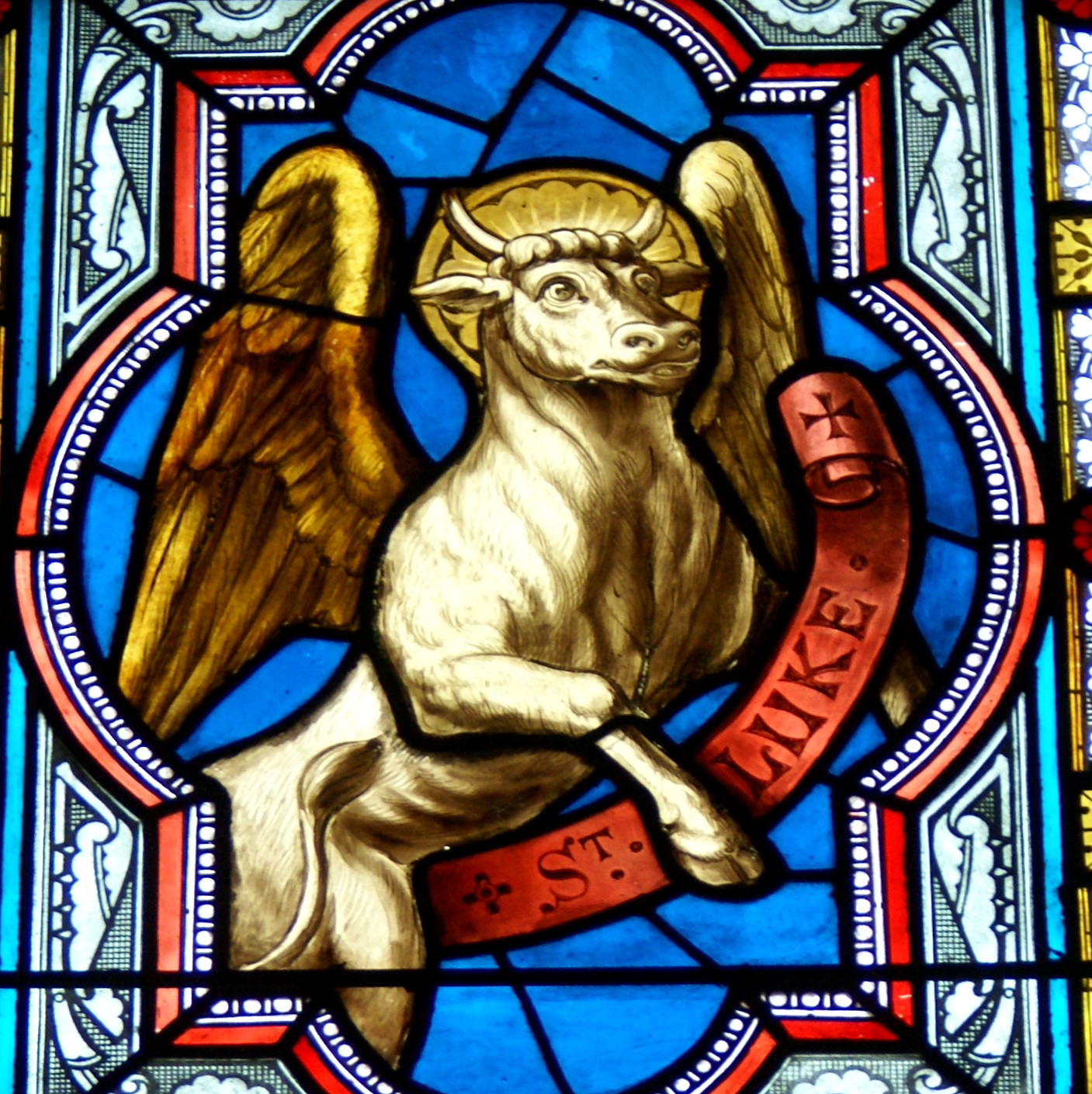
The Times They Are A-Changin': Luke and Eschatological Reversal (Part 1)

Symbol of St. Luke the Evangelist in 19th Century
Stained Glass, St. David's Episcopal Church,
Manayunk, Philadelphia (photo by author)


Bob Dylan is the greatest songwriter of the rock era of popular music. Alternately wry, humorous, absurdist, ironic, and scathing, Dylan, more than any other single artist, gave musical voice to the thoughts and aspirations of the burgeoning baby boom generation. The key to his musical success was his conscious intent both to work within and develop multiple musical traditions (English and Celtic folk, country, blues), and his encyclopedic knowledge of the various forms led him to choose his influences wisely (e.g., Woody Guthrie, Hank Williams, Bukka White, Robert Johnson, Blind Willie McTell). While still only 20 years of age, Dylan wrote the brilliant song of protest, "Blowin' in the Wind," cushioning his protests about war, freedom, and injustice with the soft pillows of rhetorical questions. A year later he abandoned subtlety, preferring instead a direct prophetic call to his elders and those in power to, as it were, get with the program that was inexorably taking place before their very eyes. I am speaking, of course, of his classic "The Times They Are A-Changin," written in October of 1963 and becoming the title track for his third album, released in Januray 1964. His lyrics are as follows:


Come gather 'round people 
Wherever you roam 
And admit that the waters 
Around you have grown 
And accept it that soon 
You'll be drenched to the bone 
If your time to you 
Is worth savin' 
Then you better start swimmin' 
Or you'll sink like a stone 
For the times they are a-changin'. 

Come writers and critics 
Who prophesize with your pen 
And keep your eyes wide 
The chance won't come again 
And don't speak too soon 
For the wheel's still in spin 
And there's no tellin' who 
That it's namin' 
For the loser now 
Will be later to win 
For the times they are a-changin'. 

Come senators, congressmen 
Please heed the call 
Don't stand in the doorway 
Don't block up the hall 
For he that gets hurt 
Will be he who has stalled 
There's a battle outside 
And it is ragin' 
It'll soon shake your windows 
And rattle your walls 
For the times they are a-changin'. 

Come mothers and fathers 
Throughout the land 
And don't criticize 
What you can't understand 
Your sons and your daughters 
Are beyond your command 
Your old road is 
Rapidly agin' 
Please get out of the new one 
If you can't lend your hand 
For the times they are a-changin'. 

The line it is drawn 
The curse it is cast 
The slow one now 
Will later be fast 
As the present now 
Will later be past 
The order is 
Rapidly fadin' 
And the first one now 
Will later be last 
For the times they are a-changin'.


The most immediate context for this song is, no doubt, the struggle for African American civil rights. Dylan, after all, had performed at Martin Luther King, Jr.'s March on Washington in August of that same year. Interestingly, however, he broadens and generalizes the theme of change in the penultimate verse, where he alludes to an incipient generational change that was, at that time, scarcely visible to the public as a whole. Moreover, he emphasizes the portentous nature of the coming societal reversal by deliberately alluding, in the final stanza, to Jesus' enigmatic logion, uttered in the aftermath of his encounter with the "rich young ruler" and  recorded in Mark 10:31: "But many who are first will be last, and the last first."


No New Testament author emphasizes the notion of this coming societal transposition more than Luke, for whom the birth of Jesus—destined to be "Savior," "Messiah/Davidide," "Lord," and the bringer of "peace" to "all the people" (panti tō laō, a reference to the people of Israel, not, as is commonly (mis)understood, to "all people" in general; Luke 2:8-14)—to a teenage peasant girl is narrated in the context of an empire-wide census enacted during the reign of Caesar Augustus (Luke 2:1-7). This is the very same "divine Caesar" who was described on his birthday by the provincial assembly of Asia as "a saviour who put an end to war and established all things," and whose appearance "exceeded the hopes of all who had anticipated good tidings" (cited in S. R. F. Price, Rituals and Power: The Roman Imperial Cult in Asia Minor [Cambridge: CUP, 1984] 54-55). It is that world, the world of the pax Romana established by military "pacification" and sustained through oppression and taxation, that was to be turned upside down by the birth of the Jewish Messiah in fulfillment of God's covenant promises to Abraham and to David. And, to those Jews who lived with the ignominy of foreign occupation of their covenanted homeland, this was "good news of great joy" (euangelizomai … charan megalēn; Luke 2:10) indeed. The reversal—indeed, the revolution— this "gospel" message entailed is then made programmatic by Luke in his narration of Jesus' reading of Isaiah 61:1-2 in the synagogue at his hometown of Nazareth (Luke 4:16-21):

He went to Nazareth, where he had been brought up, and on the Sabbath day he went into the synagogue, as was his custom. He stood up to read, and the scroll of the prophet Isaiah was handed to him. Unrolling it, he found the place where it is written:
“The Spirit of the Lord is on me,
    because he has anointed me
    to proclaim good news to the poor.
He has sent me to proclaim freedom for the prisoners
    and recovery of sight for the blind,
to set the oppressed free,
     to proclaim the year of the Lord’s favor.”
Then he rolled up the scroll, gave it back to the attendant and sat down. The eyes of everyone in the synagogue were fastened on him. He began by saying to them, “Today this scripture is fulfilled in your hearing.”

Jesus here not only makes the explicit claim, no doubt ludicrous to his auditors, that the hopes enshrined in the Isaianic prophecy were being realized there and then. He also, and just as clearly, is making the implicit and scandalous claim that he was the Spirit-anointed herald of the gospel for the poor, marginalized, and oppressed people of God.

What concerns me is how the radicalness of Jesus' (and Luke's) message has been domesticated by the church. Fuller Seminary Professor Joel Green expresses this nicely, with reference to Mary's Magnificat, recorded by Luke in Luke 1:46-55: "[M]ore often than not, we have wrapped it in antiseptic dress, spiritualized it, projected its message of redemption-by-social-transformation into the eschaton" (The Theology of the Gospel of Luke [Cambridge: CUP, 1995] 1). By and large, the evangelical church has transformed the gospel into a soteriological bit of good news about "me and my relationship with God" and ignored, at best, the societal implications latent in it. Green's lament about the eschatological projection of such implications is nowhere better evidenced than in the dispensationalism on which I cut my theological teeth, which relegated Jesus' "social" message to the Messianic "kingdom" which supposedly lay entirely in the future. Even today, with the influence of such dispensationalism receding in the undertow of theological fashion, many evangelicals who seek to make an impact in the public sector do so primarily by promoting "biblical" standards of morality, almost exclusively in the sexual arena. But does not the gospel of Jesus Christ have something to say about power? Does it not have something to tell society about how status ought to be measured? I. of course, believe it does. What I intend to do in the next couple of weeks is to look at a few passages in which Luke's theme of "eschatological reversal," the societal transposition effected by the Christ event, is prominent.

I leave you with two performances of Dylan's classic song, the first an alternative version by the great Dylan himself, and the second a take by Dave King and his brilliant Irish/punk band Flogging Molly.


Tuesday, April 2, 2013

Dallas Seminary Podcast Table Discussion on Pope Francis I


Back in February I offered a few reflections on the resignation of Pope Benedict XVI. Since that time, of course, the College of Cardinals has elected a new Bishop of Rome, the former Archbishop of Buenos Aires, Jorge Mario Bergoglio, who has taken the name of Francis I. Francis's elevation was historic in that he is the first Pope from the New World as well as the first Pope hailing from the global South. Like his two predecessors John Paul and Benedict, he is conservative theologically. Yet, in what is often jarring for Westerners, he has wed his theological conservatism to deep personal humility and an almost liberationist concern for the poor and marginalized.

How ought we who are Protestants—in particular, Evangelicals and those from the Reformed and Lutheran confessional traditions—respond? My old friend Darrell Bock has assembled a fine panel (Lanier Burns and Scott Horrell from Dallas Seminary, Leopoldo Sanchez from Concordia Seminary) to discuss this very issue, making my job much simpler! The podcast may be viewed either on Dallas Seminary's website or on YouTube. Enjoy and learn!


Monday, April 1, 2013

Opening Day: Thoughts on the 2013 Philadelphia Phillies


Today is one of the most glorious days of the year. And I'm not talking merely about the weather, even though, with a projected high of 60 degrees under partly cloudy skies, after an unusually protracted winter, spring finally has decided to make an appearance. No, it is glorious because, for fans of the Philadelphia Phillies, it is opening day of the marathon otherwise known as the 2013 major league baseball season, the 50th such opening day since I began following America's greatest sport way back in 1964.

I come to this season with the cool, hard eye of an inveterate realist. Last year, against my better judgment (and native inclinations as a Philadelphian of Irish/British extraction), I pointed to the 1965 Los Angeles Dodgers as precedent in a vain attempt to convince myself the Phils could win a sixth consecutive divisional title. Truth be told, I knew it was a stretch, as I confessed, "I wouldn't be overly surprised if they finish with between 80-85 wins and fail to reach the playoffs." Lo and behold, a late season rally enabled them to avoid the ignominy of following a 102-win season with a losing campaign, but their 81-81 record was earned on merit and cannot be blamed on the injury bug that also bit divisional champ Washington badly.

Last October I delivered a scathing post-mortem on the 2012 season that was more in keeping with my normal curmudgeonly fandom. Besides noting the obvious problems of failing to rejuvenate a roster with an aging core of veteran stars and the team's longstanding and apparently pathological inaptitude for situational hitting, I noted four questions that had to be addressed if the team was to regain its winning ways. Six months later, I would like to revisit them.

1. What can the Phillies do about Ryan Howard and Chase Utley?

The answer, apparently, is "Nothing." Even if he wanted to, GM Ruben Amaro Jr. couldn't trade them because of the massive contracts with which he saddled the team in years past (Utley is owed $13 million and Howard $25 million for 2013). The 34 year-old Utley was one of baseball's preeminent players from 2005-2009. During those five seasons he averaged 111 runs, 39 2Bs, 29 HRs, 101 RBI, and a .301 BA. But the notoriously hard-nosed style of play for which he became beloved to the blue collar Philly faithful took its toll, to the point where he can be considered this generation's Don Mattingly. Each of the past two seasons he started the season on the disabled list, and last year was limited to 83 games and 301 ABs. His 11 homers and .256 average are nowhere near to the production he generated in his peak years, though still adequate for a second baseman. The fact that he actually played (and played well, with 5 HRs in 71 ABs) this spring in the Grapefruit League has inspired hope among the team's fans. Nevertheless, to expect a return to his prime form of yesteryear is unreasonable. If he remains relatively healthy, he could hit 20 HRs or so, which would certainly be welcome. And the return of slick-fielding infielder Freddie Galvis should enable Utley to get the periodic rest he needs. The team needs a healthy Utley to remain competitive.

Howard, whom I have taken to calling "The Big Load," is another matter. Back in October's post  I demonstrated Howard's utter statistical futility against southpaw pitching, and suggested he should be made into a platoon player along with John Mayberry. That ain't gonna happen, of course. What also ain't gonna happen is a return by Howard to the form he showed in 2006-2009, when he was, apart from Albert Pujols, the most feared slugger in baseball. When in a generous mood, I am willing to grant Howard a Mulligan because, after all, last season he played while recovering from a devastating Achilles' tear. Optimists likewise will point to his numbers this spring (7 HRs, .322 BA, .972 OPS) as evidence that the old Howard is back. I tend not to be overly generous when it comes to hometown athletes, however (I am from Philadelphia, after all). And I am certainly not an optimist. Numbers such as 30 HRs and 100 RBI are certainly not out of the question, but if the Phils are to contend this year, Howard will have to be better than that. The question is, however, less "will he" than "can he?" I'm not so sure. The hope I have derives from the team's smart signing of Wally Joyner to replace Greg Gross as the team's hitting coach.

2. What can the Phillies expect from their starting rotation [this] year?

Cole Hamels seems poised to reward the team for the faith they showed in him when they gave him a contract extension last summer. The 17-game winner from a year ago had a remarkable spring (3-0, 0.95 ERA, 0.79 WHIP) and is poised to become the clear ace of the staff. Bad luck Cliff Lee also is not a concern. The same cannot be said, however, of erstwhile ace and likely future Hall-of-Famer Roy Halladay, whose injury-riddled 2012 season is increasingly looking to be a harbinger of what to expect this year. This spring he was positively awful (6.06 ERA, 1.84 WHIP) and showed no signs he will be able to regain the 90+ MPH velocity or devastating movement on his cutter he will need to regain his dominance. Halladay is the ultimate gamer (that is why he is my favorite player on the team), but the jury remains out on whether his apparent physical deterioration, whether caused by age or injury, will preclude a return to form. If all goes well, Halladay could win 15 games with an ERA of 3.50 or so, but the team will need the Halladay of 2010-2011 to seriously contend once again. The fourth and fifth spots in the rotation will be taken by junkballer Kyle Kendrick and former Washington National John Lannan, the latter of whom has never won more than 10 games in any season. The less said about these two, the better (especially considering the brutal springs each of them delivered). At best one can hope that neither loses more games than he wins. But I won't hold my breath.

3. What [did] the Phillies do to improve their bullpen?

Last year the team's relievers sported a 4.67 ERA in the 8th inning, an exceedingly ugly number that, if repeated, will derail any hopes for title contention this season. So RAJ deep-sixed the execrable Josh Lindblom and went out and picked up Mike Adams from the Texas Rangers, who last year had 27 holds and a 3.27 ERA in 61 games, and has a 2.28 career ERA in 358 games. Well done, I say! If Jonathan Papelbon performs as he did last year, and Philippe Aumont and Aaron Cook perform as they did this spring, the bullpen will be the biggest area of improvement over last season.

4. [Did] the Phillies ... solve their holes in the outfield and at third base?

The first order of business was that of addition by subtraction in the release of injury-plagued oldtimer Placido Polanco. To replace him RAJ signed Texas Ranger third baseman Michael Young. Young is a great hitter, who has a .301 lifetime BA and has surpassed 200 hits six times in his career. He is also only one season removed from a campaign in which he hit .338 and drove in 106 runs. But last season he had his worst year in a decade, with only 8 HRs and a .277 BA in 611 ABs ... and he is 36 years old. Now that baseball has thankfully entered its post-steroid era players are starting once again to show the effects of age as they historically have, and that means inexorable decline after the age of 35. So it is a legitimate question as to whether or not Young can once again summon the strength necessary to play at his former level. In any case, he is a definite improvement over the punch-and judy Polanco at the plate, even if the left hand of defense takes away what the right hand of offense gives. Thankfully, the bench is fine with the aforementioned Galvis and the hard-hitting Kevin Frandsen (.338 BA in 2012).

The outfield is another matter. RAJ made two major acquisitions. First he signed Minnesota Twins outfielder Ben Revere to play centerfield. Revere, however, was no Kirby Puckett in either shape (only 170 pounds, instead of 225, on his 5'9" frame) or production. Last season he hit .294 and stole 40 bases, both of which sound great. But, in 511 ABs, he hit only 13 doubles, 6 triples, and zero home runs. And he walked only 29 times. His slugging percentage was an anemic .342 and his on base percentage a mere .333. So what looks, at first glance, to be a perfect fit to solve the team's leadoff dilemma ends up being another question mark. (Could it be that the team is destined for yet another year of J-Stroll as the leadoff hitter? Mē genoito!) 

RAJ's second move was even more incomprehensible: the signing of underachieving, overweight (240 pounds) outfielder Delmon Young. Young is no slouch. He hit 18 HRs and batted .267 last year for the Tigers. But he has no speed (zero stolen bases in each of the last two years) and can hardly be considered a good fit for the rightfield slot Charlie Manuel apparently is leaving open for him when he returns from the disabled list. In his place it appears that a platoon of the aforementioned Mayberry and Laynce Nix ( a less-than-stellar signing from a year ago) will try to hold down the fort.

That leaves the wild card in the equation. I speak, of course, of Domonic Brown, the former highly touted prospect who has thus far failed to live up to lofty expectations. Last year he hit only .235 and slugged .396 in 187 ABs. But he remains only 25 years old and, on the strength of a stellar spring (a team-leading 7 HRs and 17 RBI, a .356 BA), has been granted the leftfield job. I know he did this in spring training, and that better MLB hurlers will attack his long, loping swing. But, for some reason, I still have high hopes for Brown, if for no other reason than his raw athleticism and the way the ball jumps off his bat when he hits it squarely. If Brown can deliver on only a fraction of his potential (and once again that's a big "if"), he stands to benefit the Phils as much as any of the pickups RAJ made this off-season.

Bottom line: if the team remains relatively healthy, they should improve upon their performance of 2012 somewhat. But that won't be enough to unseat either the Nationals or the Braves, whose rebuilt outfield is positively scary. Prediction: 85-77, third place in the NL East, and no wild card berth.

Friday, March 29, 2013

Good Friday: "When I Survey the Wondrous Cross"

(image @bbc.co,uk/arts/yourpaintings)

Crucifixion was the most gruesome, ignominious means of execution utilized by the Romans to subdue the peoples who populated their Empire. The 3rd-century Church Father Origen expressed it best in his Commentary on Matthew (on Matt 27:22ff.), when he spoke (in its Latin version) of mors turpissima crucis ("the utterly vile death of the cross").

St. Paul likewise reflects this understanding when he writes in wonder of the depths of the self-humbling (etapeinōsen heauton) of the incarnate Christ, whose obedience extended even (de) to the point of submitting to "a cross death" (thanatou staurou) (Phil 2:8). One thing was certain, to Jew and Gentile alike: a crucified "Messiah" was a mere messianic pretender. And the evidence for this was in the public domain. Not surprisingly, as Paul well knew, proclamation of a crucified Messiah and Lord was both folly (mōria) to Greeks (not to mention the Romans who had sent him to the gallows) and a stumbling block (skandalon) to Jews still waiting for a messianic deliverer (1 Cor 1:18).

Yet Paul, who had experienced his Easter on a trip to Damascus to round up Hellenist Christian rabble-rousers (Acts 9, inter alia), knew otherwise firsthand. As a result, he could speak paradoxically of the folly of the "message of the cross" (ho logos tou staurou) as the height of divine saving power and wisdom (1 Cor 1:24), and hence the content of the "gospel" (euangelion) he preached (1 Cor 1:18). Adherence to the message of the cross entailed a complete reordering of one's worldview. Whereas previously the zealous Pharisee Saul of Tarsus had placed his boast (kauchēsis) and confidence (pepoithēsis) in his Jewish identity and zeal for the Torah (Phil 3:4-6), he now considered such things, by contrast, to be "loss" (zymia) and even "crap" (skybala) in view of the greater glory of knowing Christ and possessing a right standing before God by faith (Phil 3:8). Henceforth he would only boast in Christ (Phil 3:3).

Nowhere is this clearer than in the Apostle's (probably) earliest letter, Galatians, where he writes to counteract the influence of Jewish Christian "agitators" who were insisting that Paul's Gentile converts be circumcised to become full members in God's Abrahamic covenant people. In the letter's Postscript, Paul accuses his opponents of insisting on circumcision "in order that they might boast in your flesh" (Gal 6:13). Presumably the opponents wouldn't have seen things this way—this is polemical correspondence, after all—but the fact was that such a victorious campaign on their part would have attested, according to their theological understanding, to their faithfulness to the Torah and, hence, to God. Paul, however, in supreme irony, counters with some of the most profound words ever to come from his pen:
But God forbid for me to boast except in the cross of our Lord Jesus Christ, by which the world has been crucified to me, and I to the world (Gal 6:14).
The cross, of course, is the very cross on which Christ was "cursed" for "us" (i.e., Jewish Christians, in whose stead he bore the covenant curse they had incurred (Gal 3:13, with 3:10), thus freeing the "blessing of Abraham" to be extended, as God had promised, to the Gentiles (Gal 3:14). It is the cross whose significance would be nullified if people could be "justified" by adherence to the redundant Torah's demands (Gal 2:21). And it is the cross, the locus of Christ's supreme demonstration of love for his people, that, via our incorporation into the crucified Jesus, enables us to "live for God" even as it signaled our "death to the Torah" (Gal 2:19-20). It is this profound truth that Paul reiterates memorably in Galatians 6:14b. Through Christ's historisch crucifixion a further reciprocal (theological) crucifixion occurred, viz., the "world" to the believer and the believer to the world. In other words, through the believer's corporate participation in the once-for-all death of Christ, the relationship which the believer had with the world by virtue of physical birth has been severed completely. Hence he or she has been rescued from its dominion and made a partaker of the new creation (Gal 6:15) inaugurated by the accursed cross and the vindicating resurrection (Gal 1:1) which followed two days later and served, in part, to interpret the cross's significance.

No one understood the implications of this text better than the "Father of English Hymnody," the great Nonconformist scholar and theologian Isaac Watts. Though he wrote a textbook on Logic that was in use at Oxbridge for a hundred years, Watts is today best known as the earliest and, along with Charles Wesley, the greatest hymn writer the English-speaking world has produced. Among the 800 or so hymns he wrote, Watts produced such enduring classics as "Joy to the World," "Alas! And Did My Savior Bleed," "I Sing the Mighty Power of God," and "O God, Our Help in Ages Past." But without a doubt his greatest hymn, one which the great Wesley once said he would have traded every one he had ever written if only he could have written this one, is the immortal "When I Survey the Wondrous Cross," originally published in 1707 in his collection, Hymns and Spiritual Songs. The verses, which need no commentary, read thus:

When I survey the wondrous cross
On which the Prince of glory died,
My richest gain I count but loss,
And pour contempt on all my pride.

Forbid it, Lord, that I should boast,
Save in the death of Christ my God!
All the vain things that charm me most,
I sacrifice them to His blood.

See from His head, His hands, His feet,
Sorrow and love flow mingled down!
Did e’er such love and sorrow meet,
Or thorns compose so rich a crown?

His dying crimson, like a robe,
Spreads o’er His body on the tree;
Then I am dead to all the globe,
And all the globe is dead to me.

Were the whole realm of nature mine,
That were a present far too small;
Love so amazing, so divine,
Demands my soul, my life, my all.

I leave you with a splendidly refined performance of this hymn (set to the 1790 Rockingham tune as arranged by John Rutter) by the Choir of Kings College, Cambridge: